Chăm sóc người thân mắc serious mental illness
Caring for a family member with serious mental illness
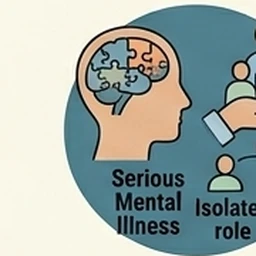
Serious mental illness — schizophrenia, bipolar I, severe major depression with psychotic features — is one of the most isolating caregiving roles in the US. The patient is often an adult child whose illness emerged in their late teens or twenties, and the family inherits decades of coordination work the medical system was never built to share. Here's the orientation.
Điều gì thay đổi đối với gia đình
Serious mental illness (SMI) reshapes a family along several axes the standard caregiver narrative doesn't cover. The patient is often a younger adult — schizophrenia typically emerges in the late teens or 20s, bipolar I in the 20s — meaning families face decades of caregiving rather than the late-life arc most caregiver resources assume. The medical system rarely sees the family as part of the team: HIPAA and the patient's autonomy rights mean the family is often informed only at hospitalization, sometimes not even then. The patient's relationship with treatment can be inconsistent (the "lack of insight" — anosognosia — that comes with some psychotic disorders is a clinical feature, not the patient being difficult). Housing, employment, benefits, the criminal-legal system, and substance use frequently intersect. And the stigma is real, both externally (housing discrimination, employment discrimination) and within families (the parents-of-an-adult-child-with-SMI cohort is one of the most isolated caregiver populations in the literature). NAMI — the National Alliance on Mental Illness — is the central family organization, and the single most useful first call.
Những điều nên sắp xếp sớm
Khoảng thời gian ngay sau khi có chẩn đoán là lúc quý vị có nhiều dư địa nhất để dựng nên cấu trúc mà cả chặng đường phía sau sẽ tựa vào. Quý vị càng trì hoãn, một số việc dưới đây càng trở nên khó khăn hơn.
- A NAMI Family-to-Family course. 8 weeks, free, taught by trained family-member volunteers. Most attendees describe it as the most useful single thing they did in their caregiving arc. The Family Support Group (an ongoing version) is just as useful for the long term.
- Connection to an assertive community treatment (ACT) team if available in your area. ACT teams (multidisciplinary teams that work with SMI patients in the community) are the most evidence-based model for severe-and-persistent mental illness; under-utilized because they're hard to find. State mental-health authority can locate one.
- Documentation work while cooperation is possible: signed releases for the family to receive clinical information (HIPAA authorization), durable POA for healthcare, possibly a psychiatric advance directive that documents the patient's preferences for future treatment when they're well.
- A relationship with a psychiatrist who specializes in SMI (often a "first-episode psychosis" or "early-onset" specialist if the patient is younger). Care continuity matters more in SMI than almost any other condition; the wrong handoff can disrupt years of stability.
- Benefits + housing setup: SSI/SSDI application, Section 8 if relevant, Medicaid (often the only insurance that covers long-term outpatient psychiatric care), state mental-health-authority case-management enrollment. The benefits navigation is its own job.
- A crisis plan that's written down before crisis. The right phone numbers (988, the patient's case manager, the psychiatrist's on-call, local mobile crisis team, the family's designated decision-maker), the patient's current medications, prior hospitalizations, the things that have worked + the things that haven't. Save in everyone's phone.
Những khoảnh khắc khó khăn nhất
Những khoảnh khắc mà các gia đình mô tả là khó khăn nhất thường là những khoảnh khắc không ai báo trước cho họ. Biết được điều gì có khả năng xảy ra không làm cho bất kỳ khoảnh khắc nào trong đó dễ chịu hơn — nhưng có một cái tên cho chúng, và có một không gian làm việc giúp đưa gia đình trở lại bên nhau khi chúng xảy ra, thì sẽ đỡ hơn nhiều.
- A first psychotic break or first manic episode. The patient is often someone the family knew completely; the disease that emerges is unfamiliar. The hospitalization is short; the discharge often premature; the family is left to figure out what comes next with very little support.
- Medication non-adherence. Anosognosia (the clinical lack of insight into one's own illness) is common in schizophrenia and means the patient genuinely doesn't experience themselves as ill. Long-acting injectable medications can help; involuntary medication is a fraught legal process; family pressure rarely works long-term.
- A police or criminal-justice encounter. People with SMI are disproportionately likely to interact with police; outcomes range from a calm crisis intervention team encounter to a fatal one. Mobile crisis teams (in regions that have them) are dramatically safer than 911. Build the alternative numbers into the crisis plan.
- The long arc. Unlike most caregiving roles, SMI caregiving often continues for decades with episodic crises rather than a clear trajectory. Caregiver burnout is the rule. The structural answer is respite + support groups + therapy for the caregiver, all started early.
Các hướng dẫn liên quan đến tình trạng này
Các hướng dẫn của Kintaria là từng bước cho những khoảnh khắc cụ thể xuất hiện trong hành trình chăm sóc này. Mỗi hướng dẫn sẽ mở ra trong không gian làm việc của quý vị và được cá nhân hoá theo câu trả lời của quý vị.
- Adult child · Before the 18th birthdayYou need to set up the special-needs trust and guardianship.
- Adult child with disabilities · Future planningWhen you are the parent-caregiver and you need to plan for after you.
- Wellness · OngoingWhen you're burning out.
- Foundation · One-time setupGet the legal paperwork in order.
- Sibling · Inheriting the careYour parent was caring for your sibling — and now they can't.
Các tổ chức quốc gia và đường dây hỗ trợ
Đây là những tổ chức được giới chuyên môn xem là điểm khởi đầu chuẩn mực. Tất cả đều miễn phí, và tất cả đều có người trực tổng đài (đường dây trợ giúp người chăm sóc do AI vận hành là một thể loại khác — ở đây là những người đã được đào tạo cụ thể về tình trạng này).
- HelpLine · 1-800-950-6264 (text 62640) · Crisis: 988
The central family-side mental-health organization in the US. NAMI HelpLine answers calls from families. Family-to-Family course (8 weeks, free) is the single most-recommended resource. Local affiliates run support groups + advocacy.
- 988 · 24/7
For acute crisis. Free, confidential, doesn't auto-dispatch police. Trained counselors. Can connect to local mobile crisis teams where they exist (a meaningfully safer alternative to 911 for mental-health crises).
- 1-800-662-4357 · 24/7 · English + Spanish
Federal substance-abuse + mental-health services helpline. Free, confidential, doesn't require insurance. Useful when the SMI overlaps with substance use (which it often does).
Policy-focused organization specifically on access to SMI treatment. Strong resources on assisted outpatient treatment (AOT) laws, anosognosia, and the civil-commitment landscape state by state. Useful when the family is navigating involuntary-treatment questions.
Schizophrenia-specific patient + family advocacy. Online community, family-support resources, advocacy on policy that affects people with psychotic disorders.
- Helpline · 1-800-826-3632
For bipolar + severe-depression cohorts. Peer-led support groups across the country, education programs, wellness tools. The bipolar-specific community is the most engaged.
Authoritative US government plain-language overview. Free, comprehensive.
Không gian làm việc Kintaria giúp được gì
Kintaria là một không gian gia đình chung, dịu dàng, được dựng lên cho khối công việc mà chẩn đoán này sắp tạo ra. Danh sách thuốc nằm ở một chỗ (để người em thứ ba bay về vào cuối tuần không phải học lại từ đầu xem có gì thay đổi). Lịch khám được chia sẻ (để gia đình không đặt trùng lịch hoặc bỏ sót buổi tái khám với chuyên khoa thấp khớp). Dòng hoạt động nói thật về việc ai đã làm gì (để người chăm sóc chính không lặng lẽ gánh hết). Và không gian này song ngữ — người bệnh đọc bằng ngôn ngữ họ thấy dễ chịu hơn, còn gia đình đọc bằng tiếng Anh — điều mà mọi người thường đánh giá thấp tầm quan trọng cho đến khi chẩn đoán đã khiến mọi thứ rối loạn.
Dùng thử miễn phí 1 năm dành cho 500 gia đình sáng lập đầu tiên. Không cần thẻ tín dụng.
Một lời nhắc về Kintaria là gì (và không phải là gì)
Kintaria không phải là công cụ lâm sàng, không thay thế cho quyết định y khoa, và không thay thế cho đội ngũ chăm sóc serious mental illness. Nội dung trên trang này dành cho các gia đình đang phối hợp việc chăm sóc; những quyết định lâm sàng cụ thể cần được bác sĩ của người bệnh đưa ra. Các dấu hiệu cần báo cáo khẩn cấp xuất hiện xuyên suốt không gian làm việc đều trung thực về ranh giới đó.
Các thuật ngữ chăm sóc xuất hiện trên trang này
Những từ quý vị có thể muốn tra nghĩa trong khi đọc. Mỗi từ sẽ mở ra trang riêng với phần định nghĩa bằng ngôn ngữ dễ hiểu và cách từ đó xuất hiện trong việc chăm sóc.
- Case manager — A nurse or social worker employed by the hospital whose job is to coordinate care across the system — most importantly, discharge planning.
- Power of attorney — A legal document where one person (the "principal") authorizes another person (the "agent" or "attorney-in-fact") to act on their behalf in financial matters.
- Advance directive — A written document specifying a patient's wishes for end-of-life medical care — typically covering CPR, mechanical ventilation, artificial nutrition, and other interventions when recovery is unlikely.
- HIPAA authorization — A signed form authorizing a healthcare provider to release the patient's information to a named family member or other party.
- Medicaid — Joint federal-state program covering health care for low-income people, including many people with disabilities and many older adults who have spent down their assets.
- Caregiver burnout — A state of physical, emotional, and mental exhaustion that develops over months or years of caregiving — characterized by chronic fatigue, irritability, isolation, anxiety, depression, sleep disturbance, and worsening physical health.
Xem thêm: tất cả các tình trạng · tất cả các hướng dẫn · từ điển dành cho người chăm sóc · danh bạ tài nguyên toàn quốc