照护患有heart failure的亲人
Caring for someone with heart failure
Heart failure is a chronic-disease management problem more than a single-moment crisis. The work is steady, repetitive, and load-bearing — daily weights, sodium tracking, medication adherence, recognizing decompensation early. The families who do it well prevent most of the hospital readmissions. Here's the orientation.
家庭会发生什么变化
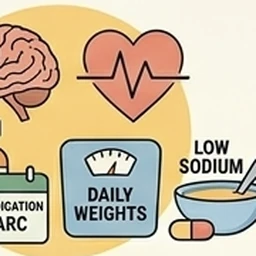
Heart failure (HF or CHF) doesn't produce a single dramatic before-and-after — it produces a long sequence of small management decisions where the cost of getting it wrong is a 3-day hospital stay every few months. The caregiver becomes a daily monitor: weight at the same time each morning, sodium intake across the day, fluid intake under a target, and an ear for the early symptoms of fluid overload (shortness of breath at night, swollen ankles, sudden 2-3 pound overnight weight gain). The medication regimen is usually 5-8 drugs, often with a diuretic that has to be timed around the patient's day. The relationship reorganizes around the rhythm: the caregiver who didn't want to be the medication tracker becomes one anyway, and the patient who didn't want to be told what to eat has to be. Most heart failure caregivers describe the chronic-disease patience required as the hardest part — there's no resolution, just a year of weeks where the goal is "no readmission this month."
需要尽早安排的事情
诊断之后的窗口期,是您的家庭最有余地去搭建后续整个旅程将依靠的结构的时刻。您拖得越久,其中一些事情就越难处理。
- A daily weight log + a written "if your weight is up X pounds in Y days, call the clinic" plan. Most cardiology teams give a written zone plan (green / yellow / red); if yours hasn't, ask. This is the single highest-leverage caregiver intervention in heart failure.
- A medication list the patient + caregiver + clinician all agree on. Heart failure medications change frequently as the dose is titrated; a stale list causes errors. The shared workspace makes this easier.
- A sodium-tracking habit. Hidden sodium is the hard part — restaurant food, canned soup, bread, deli meat. Most patients tolerate 2,000 mg/day; the cardiology team has the actual target. The first 30 days of learning this matters more than the next year.
- Legal documents while the patient is stable: durable POA, healthcare POA, advance directive. Advanced heart failure brings sudden decompensations; the paperwork should be done before one of those hospitalizations.
- A referral to cardiac rehab if eligible. Cardiac rehab is the most evidence-based intervention for quality of life in heart failure and the most under-prescribed. Ask if it wasn't offered.
- A conversation about goals of care — what the patient wants from the next year. Heart failure has a more predictable late trajectory than most diseases; talking about it early is easier than talking about it during the hospital admission that forces it.
最艰难的时刻
家庭描述为最艰难的时刻,往往是没有人提前提醒过他们的那些时刻。知道接下来可能发生什么,并不会让任何一刻变得容易——但能给这些时刻一个名字,并拥有一个在它们发生时能让家人重新聚拢起来的工作空间,会有帮助。
- The first hospital admission for decompensation after a stable period. It's easy to interpret as a setback that "must have a reason"; usually the reason is that heart failure progresses. Reframing this as the disease, not the family's management failure, is the first hard conversation.
- The shift from "still driving, still active" to "needs help with stairs." Heart failure progression is often visible in exertion tolerance more than anything else; the day a familiar walk becomes too much is one families describe as hard.
- The advanced-therapies conversation — LVAD, transplant evaluation, or palliative care. Each requires a high-stakes decision; the conversation is best had with a heart-failure cardiologist (not a general cardiologist) and the family together.
- The decision to stop aggressive treatment and pursue comfort. Advanced heart failure has clear inflection points; most families wish they had asked about hospice earlier than they did.
与此相关的指南
Kintaria 的指南是针对这条照护路径上具体时刻的分步说明。每一份都会在您的工作空间中打开,并根据您的回答进行个性化调整。
- Hospital · 48-hour windowYour parent was just discharged from a hospital.
- Foundation · One-time setupGet the legal paperwork in order.
- Spouse · OngoingWhen you are the caregiver-spouse.
- Parent · This is real nowYour parent is in the ER for the first time.
- Transition · HospiceYou think your parent may be approaching the end of life.
全国性组织与求助热线
这些是业内公认的标准起点。全部免费,并且都是真人接听的求助热线(针对照护者的 AI 电话热线属于另一类——这里指的是接受过该具体疾病培训的人员)。
- Support Network · 24/7
Educational resources, a caregiver-specific Support Network for connecting with families navigating the same diagnosis, "Rise Above Heart Failure" patient-and-family materials.
Clinician-facing primary, but the patient + caregiver section has condition-specific guides ("Managing Your Heart Failure," nutrition + medication primers).
- 1-888-432-7899
Peer-support organization for heart patients and their families. National network of accredited visitors (patients who have lived through what your loved one is facing), hospital visiting programs, support groups.
Patient-and-family arm of the American College of Cardiology. Plain-language guides, decision tools, condition-specific videos.
Authoritative US government overview. Free, comprehensive, plain-language.
Kintaria 工作空间如何提供帮助
Kintaria 是一个为这次诊断即将带来的工作而设计的、平静的、共享的家庭工作空间。用药清单集中在一个地方(这样周末飞回来的第三个兄弟姐妹就不必重新弄清楚有什么变化)。就诊日历是共享的(这样家人就不会重复预约或漏掉风湿科的复诊)。活动记录如实记录谁做了什么(这样主要照护者就不会默默承担一切)。并且工作空间是双语的——患者用自己更习惯的语言阅读,家人用英语阅读——当诊断本身已经让人手足无措时,这一点比人们以为的更重要。
前 500 个创始家庭可享 1 年免费试用。无需信用卡。
关于 Kintaria 是什么(以及不是什么)的说明
Kintaria 不是临床工具,不能替代医学决定,也不能取代heart failure的照护团队。本页的内容是面向协调照护工作的家庭的导览;具体的临床决定需要由患者的医生作出。整个工作空间中的升级提示对这一界线是诚实的。
本页中的照护术语
您在阅读时可能希望先了解定义的词。每一个都会打开一个独立页面,提供平实的含义说明以及在照护中如何出现。
- Palliative care — Specialty care focused on quality of life and symptom relief for people with serious illness.
- Hospice — A type of care for people with a life expectancy of about 6 months or less, focused entirely on comfort rather than cure.
- Power of attorney — A legal document where one person (the "principal") authorizes another person (the "agent" or "attorney-in-fact") to act on their behalf in financial matters.
- Healthcare proxy — A legal document naming a person to make medical decisions if the patient cannot.
- Advance directive — A written document specifying a patient's wishes for end-of-life medical care — typically covering CPR, mechanical ventilation, artificial nutrition, and other interventions when recovery is unlikely.
- Readmission — A return to the hospital within 30 days of discharge.