Cuidando a un ser querido con heart failure
Caring for someone with heart failure
Heart failure is a chronic-disease management problem more than a single-moment crisis. The work is steady, repetitive, and load-bearing — daily weights, sodium tracking, medication adherence, recognizing decompensation early. The families who do it well prevent most of the hospital readmissions. Here's the orientation.
Lo que cambia para la familia
Heart failure (HF or CHF) doesn't produce a single dramatic before-and-after — it produces a long sequence of small management decisions where the cost of getting it wrong is a 3-day hospital stay every few months. The caregiver becomes a daily monitor: weight at the same time each morning, sodium intake across the day, fluid intake under a target, and an ear for the early symptoms of fluid overload (shortness of breath at night, swollen ankles, sudden 2-3 pound overnight weight gain). The medication regimen is usually 5-8 drugs, often with a diuretic that has to be timed around the patient's day. The relationship reorganizes around the rhythm: the caregiver who didn't want to be the medication tracker becomes one anyway, and the patient who didn't want to be told what to eat has to be. Most heart failure caregivers describe the chronic-disease patience required as the hardest part — there's no resolution, just a year of weeks where the goal is "no readmission this month."
Lo que conviene organizar temprano
La ventana después del diagnóstico es cuando la familia tiene más margen para establecer la estructura sobre la que se apoyará el resto del camino. Mientras más espere, más difícil se vuelve cada uno de estos pasos.
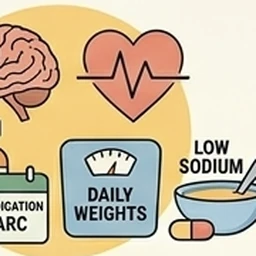
- A daily weight log + a written "if your weight is up X pounds in Y days, call the clinic" plan. Most cardiology teams give a written zone plan (green / yellow / red); if yours hasn't, ask. This is the single highest-leverage caregiver intervention in heart failure.
- A medication list the patient + caregiver + clinician all agree on. Heart failure medications change frequently as the dose is titrated; a stale list causes errors. The shared workspace makes this easier.
- A sodium-tracking habit. Hidden sodium is the hard part — restaurant food, canned soup, bread, deli meat. Most patients tolerate 2,000 mg/day; the cardiology team has the actual target. The first 30 days of learning this matters more than the next year.
- Legal documents while the patient is stable: durable POA, healthcare POA, advance directive. Advanced heart failure brings sudden decompensations; the paperwork should be done before one of those hospitalizations.
- A referral to cardiac rehab if eligible. Cardiac rehab is the most evidence-based intervention for quality of life in heart failure and the most under-prescribed. Ask if it wasn't offered.
- A conversation about goals of care — what the patient wants from the next year. Heart failure has a more predictable late trajectory than most diseases; talking about it early is easier than talking about it during the hospital admission that forces it.
Los momentos más difíciles
Los momentos que las familias describen como los más difíciles suelen ser aquellos sobre los que nadie las advirtió. Saber lo que probablemente viene no hace que ninguno sea fácil — pero tener un nombre para ellos, y un espacio de trabajo que vuelva a unir a la familia cuando ocurren, sí ayuda.
- The first hospital admission for decompensation after a stable period. It's easy to interpret as a setback that "must have a reason"; usually the reason is that heart failure progresses. Reframing this as the disease, not the family's management failure, is the first hard conversation.
- The shift from "still driving, still active" to "needs help with stairs." Heart failure progression is often visible in exertion tolerance more than anything else; the day a familiar walk becomes too much is one families describe as hard.
- The advanced-therapies conversation — LVAD, transplant evaluation, or palliative care. Each requires a high-stakes decision; the conversation is best had with a heart-failure cardiologist (not a general cardiologist) and the family together.
- The decision to stop aggressive treatment and pursue comfort. Advanced heart failure has clear inflection points; most families wish they had asked about hospice earlier than they did.
Planes que se relacionan con esto
Los planes de Kintaria son guías paso a paso para los momentos específicos que aparecen en este recorrido de cuidado. Cada uno se abre en su espacio de trabajo y se personaliza con sus respuestas.
- Hospital · 48-hour windowYour parent was just discharged from a hospital.
- Foundation · One-time setupGet the legal paperwork in order.
- Spouse · OngoingWhen you are the caregiver-spouse.
- Parent · This is real nowYour parent is in the ER for the first time.
- Transition · HospiceYou think your parent may be approaching the end of life.
Organizaciones nacionales y líneas de ayuda
Estas son las organizaciones que el sector considera los puntos de partida estándar. Todas son gratuitas y todas tienen líneas atendidas por personas reales (la línea telefónica de IA para cuidadores es otra categoría — aquí se trata de personas capacitadas en la condición específica).
- Support Network · 24/7
Educational resources, a caregiver-specific Support Network for connecting with families navigating the same diagnosis, "Rise Above Heart Failure" patient-and-family materials.
Clinician-facing primary, but the patient + caregiver section has condition-specific guides ("Managing Your Heart Failure," nutrition + medication primers).
- 1-888-432-7899
Peer-support organization for heart patients and their families. National network of accredited visitors (patients who have lived through what your loved one is facing), hospital visiting programs, support groups.
Patient-and-family arm of the American College of Cardiology. Plain-language guides, decision tools, condition-specific videos.
Authoritative US government overview. Free, comprehensive, plain-language.
Cómo ayuda un espacio Kintaria
Kintaria es un espacio familiar compartido y tranquilo, diseñado para el trabajo que este diagnóstico está por generar. La lista de medicamentos vive en un solo lugar (para que el tercer hermano que vuela el fin de semana no tenga que volver a aprender qué cambió). El calendario de citas es compartido (para que la familia no duplique citas ni pierda el control de seguimiento de reumatología). El historial de actividad es honesto sobre quién hizo qué (para que el cuidador principal no cargue todo en silencio). Y el espacio es bilingüe — el paciente lee en su idioma preferido, la familia lee en inglés — lo cual importa más de lo que la gente espera cuando el diagnóstico mismo ya es desorientador.
Prueba gratuita de 1 año para las primeras 500 familias fundadoras. Sin tarjeta de crédito.
Una nota sobre lo que Kintaria es (y no es)
Kintaria no es una herramienta clínica, no es un sustituto de las decisiones médicas, no reemplaza al equipo de atención de heart failure. La orientación de esta página es para familias que coordinan el cuidado; las decisiones clínicas específicas las debe tomar el clínico del paciente. Los mensajes de escalada en todo el espacio son honestos sobre ese límite.
Términos de cuidado en esta página
Palabras que quizá quiera tener definidas mientras lee esto. Cada una abre su propia página con el significado en lenguaje sencillo y cómo aparece en el cuidado.
- Palliative care — Specialty care focused on quality of life and symptom relief for people with serious illness.
- Hospice — A type of care for people with a life expectancy of about 6 months or less, focused entirely on comfort rather than cure.
- Power of attorney — A legal document where one person (the "principal") authorizes another person (the "agent" or "attorney-in-fact") to act on their behalf in financial matters.
- Healthcare proxy — A legal document naming a person to make medical decisions if the patient cannot.
- Advance directive — A written document specifying a patient's wishes for end-of-life medical care — typically covering CPR, mechanical ventilation, artificial nutrition, and other interventions when recovery is unlikely.
- Readmission — A return to the hospital within 30 days of discharge.
Ver también: todas las condiciones · todos los planes · glosario de cuidado · directorio nacional de recursos