heart failureを抱えるご家族の介護
Caring for someone with heart failure
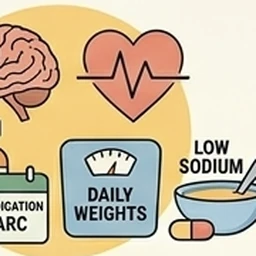
Heart failure is a chronic-disease management problem more than a single-moment crisis. The work is steady, repetitive, and load-bearing — daily weights, sodium tracking, medication adherence, recognizing decompensation early. The families who do it well prevent most of the hospital readmissions. Here's the orientation.
家族にとって何が変わるか
Heart failure (HF or CHF) doesn't produce a single dramatic before-and-after — it produces a long sequence of small management decisions where the cost of getting it wrong is a 3-day hospital stay every few months. The caregiver becomes a daily monitor: weight at the same time each morning, sodium intake across the day, fluid intake under a target, and an ear for the early symptoms of fluid overload (shortness of breath at night, swollen ankles, sudden 2-3 pound overnight weight gain). The medication regimen is usually 5-8 drugs, often with a diuretic that has to be timed around the patient's day. The relationship reorganizes around the rhythm: the caregiver who didn't want to be the medication tracker becomes one anyway, and the patient who didn't want to be told what to eat has to be. Most heart failure caregivers describe the chronic-disease patience required as the hardest part — there's no resolution, just a year of weeks where the goal is "no readmission this month."
早めに整えておきたいこと
診断後の期間は、これから先の道のり全体が支えにする構造を、ご家族が最もよく整えられるタイミングです。先延ばしにすればするほど、ここに挙げた事柄のいくつかは難しくなっていきます。
- A daily weight log + a written "if your weight is up X pounds in Y days, call the clinic" plan. Most cardiology teams give a written zone plan (green / yellow / red); if yours hasn't, ask. This is the single highest-leverage caregiver intervention in heart failure.
- A medication list the patient + caregiver + clinician all agree on. Heart failure medications change frequently as the dose is titrated; a stale list causes errors. The shared workspace makes this easier.
- A sodium-tracking habit. Hidden sodium is the hard part — restaurant food, canned soup, bread, deli meat. Most patients tolerate 2,000 mg/day; the cardiology team has the actual target. The first 30 days of learning this matters more than the next year.
- Legal documents while the patient is stable: durable POA, healthcare POA, advance directive. Advanced heart failure brings sudden decompensations; the paperwork should be done before one of those hospitalizations.
- A referral to cardiac rehab if eligible. Cardiac rehab is the most evidence-based intervention for quality of life in heart failure and the most under-prescribed. Ask if it wasn't offered.
- A conversation about goals of care — what the patient wants from the next year. Heart failure has a more predictable late trajectory than most diseases; talking about it early is easier than talking about it during the hospital admission that forces it.
もっともつらい瞬間
ご家族がもっともつらかったと語る瞬間は、誰も事前に教えてくれなかった瞬間であることがよくあります。これから起こりうることを知っていても、どの瞬間も楽になるわけではありません。それでも、その瞬間に名前を与えられること、そしてその瞬間が来たときに家族を再び結びつけてくれるワークスペースがあることは、確かに助けになります。
- The first hospital admission for decompensation after a stable period. It's easy to interpret as a setback that "must have a reason"; usually the reason is that heart failure progresses. Reframing this as the disease, not the family's management failure, is the first hard conversation.
- The shift from "still driving, still active" to "needs help with stairs." Heart failure progression is often visible in exertion tolerance more than anything else; the day a familiar walk becomes too much is one families describe as hard.
- The advanced-therapies conversation — LVAD, transplant evaluation, or palliative care. Each requires a high-stakes decision; the conversation is best had with a heart-failure cardiologist (not a general cardiologist) and the family together.
- The decision to stop aggressive treatment and pursue comfort. Advanced heart failure has clear inflection points; most families wish they had asked about hospice earlier than they did.
これに対応するプレイブック
Kintaria のプレイブックは、この介護の道のりで実際に出てくる具体的な場面のための、ステップ・バイ・ステップの手引きです。それぞれがあなたのワークスペース内で開き、あなたの回答に応じてパーソナライズされます。
- Hospital · 48-hour windowYour parent was just discharged from a hospital.
- Foundation · One-time setupGet the legal paperwork in order.
- Spouse · OngoingWhen you are the caregiver-spouse.
- Parent · This is real nowYour parent is in the ER for the first time.
- Transition · HospiceYou think your parent may be approaching the end of life.
全国規模の団体と電話相談窓口
これらは、この分野で標準的な出発点とされている団体です。すべて無料で、すべて実在の担当者が対応する電話相談窓口です(介護者向けの AI 電話相談はまた別のカテゴリーで、ここでは特定の疾患の研修を受けた人を指します)。
- Support Network · 24/7
Educational resources, a caregiver-specific Support Network for connecting with families navigating the same diagnosis, "Rise Above Heart Failure" patient-and-family materials.
Clinician-facing primary, but the patient + caregiver section has condition-specific guides ("Managing Your Heart Failure," nutrition + medication primers).
- 1-888-432-7899
Peer-support organization for heart patients and their families. National network of accredited visitors (patients who have lived through what your loved one is facing), hospital visiting programs, support groups.
Patient-and-family arm of the American College of Cardiology. Plain-language guides, decision tools, condition-specific videos.
Authoritative US government overview. Free, comprehensive, plain-language.
Kintaria のワークスペースがどう役立つか
Kintaria は、この診断がこれから生み出す仕事のために設計された、穏やかで共有可能な家族のワークスペースです。お薬リストは 1 か所にまとまっており、週末に飛行機で帰ってくる 3 番目のきょうだいが「何が変わったか」を一から学び直さずに済みます。診察の予定は共有されていて、家族が予定を重ねたり、リウマチ科のフォローアップを見落としたりしにくくなります。アクティビティの記録は「誰が何をしたか」について正直で、主たる介護者がすべてを黙って抱え込まなくて済みます。そしてワークスペースはバイリンガルです — 患者さまはご自身が楽な言語で読み、ご家族は英語で読みます — 診断そのものですでに頭が回らない状況では、この点は多くの人が想像する以上に重要になります。
創設の最初の 500 ご家族には 1 年間の無料トライアルをご提供します。クレジットカードは不要です。
Kintaria が何であり、何でないかについての一文
Kintaria は臨床ツールではなく、医療上の意思決定の代わりになるものでもなく、heart failureの医療チームの代わりになるものでもありません。このページの内容は、介護を調整するご家族のためのオリエンテーションです。個別の臨床判断は、患者さまの担当医師が行う必要があります。ワークスペース全体で示されるエスカレーションのサインは、その境界について正直に書かれています。
このページに出てくる介護用語
お読みになりながら意味を確認したくなりそうな言葉です。それぞれが独立したページで開き、わかりやすい言葉での意味と、介護の現場でどのように出てくるかを説明します。
- Palliative care — Specialty care focused on quality of life and symptom relief for people with serious illness.
- Hospice — A type of care for people with a life expectancy of about 6 months or less, focused entirely on comfort rather than cure.
- Power of attorney — A legal document where one person (the "principal") authorizes another person (the "agent" or "attorney-in-fact") to act on their behalf in financial matters.
- Healthcare proxy — A legal document naming a person to make medical decisions if the patient cannot.
- Advance directive — A written document specifying a patient's wishes for end-of-life medical care — typically covering CPR, mechanical ventilation, artificial nutrition, and other interventions when recovery is unlikely.
- Readmission — A return to the hospital within 30 days of discharge.
関連リンク: すべての疾患 · すべてのプレイブック · 介護者用語集 · 全国リソース一覧