Cuidando a un ser querido con ALS
Caring for someone with ALS
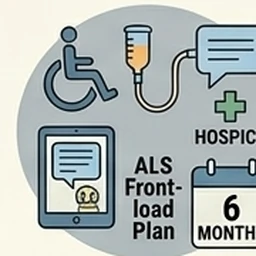
ALS moves fast. The decisions that take a year in most diseases — equipment, communication aids, feeding, hospice — often need to happen in the first six months. The families who do this well front-load the conversations while the patient can still drive them. Here's the orientation.
Lo que cambia para la familia
ALS (also called Lou Gehrig's disease or motor neuron disease) is a progressive paralysis of voluntary muscle while cognition is mostly preserved. Median survival from diagnosis is 2-5 years; some patients live decades, some less than a year. The work for the family compresses the typical caregiving arc: equipment decisions (wheelchair, communication device, feeding tube, breathing support) that would take years in other diseases often need to happen in months. The patient is usually fully cognitively present through most of the trajectory — meaning they participate in their own care decisions in ways most progressive-disease patients can't. The caregiver role intensifies fast: the spouse who started as a partner becomes a 24/7 caregiver inside 18 months in many cases, and the financial weight (lost income on both sides, $200K+ in out-of-pocket costs is common) is a constant pressure. The ALS community — clinicians, organizations, peer families — is one of the most generous and well-organized in any disease.
Lo que conviene organizar temprano
La ventana después del diagnóstico es cuando la familia tiene más margen para establecer la estructura sobre la que se apoyará el resto del camino. Mientras más espere, más difícil se vuelve cada uno de estos pasos.
- A referral to an ALS Association Certified Clinic or ALS multidisciplinary clinic. Outcomes are measurably better in these settings (where neurology, pulmonology, PT, OT, SLP, nutrition, and social work see the patient on the same visit). The ALS Association clinic locator finds the nearest one.
- Legal documents immediately. Durable POA, healthcare POA, advance directive, will. ALS can affect speech early — getting these signed while signing + speaking is unambiguous matters more here than in almost any other condition.
- A communication-device evaluation early, even before it's needed. Speech-generating devices (SGDs) take weeks to procure and customize; setting up the voice banking app on the patient's phone in the first month captures the patient's own voice for synthesis later.
- A conversation about ventilation. Most ALS patients eventually face a decision about non-invasive (BiPAP) and ultimately invasive (tracheostomy) ventilation. These are deeply personal decisions; they go better when discussed before they're needed.
- A conversation about feeding tube (PEG) placement. Recommended earlier rather than later in ALS — most clinicians suggest placement before vital capacity drops below 50%. The decision is reversible; the procedure is harder when respiratory function is worse.
- Connection with a local ALS Association chapter for equipment loans, support groups, and family-services social work. The chapter network is one of the field's most generous — wheelchairs, communication devices, and equipment frequently available at no cost.
Los momentos más difíciles
Los momentos que las familias describen como los más difíciles suelen ser aquellos sobre los que nadie las advirtió. Saber lo que probablemente viene no hace que ninguno sea fácil — pero tener un nombre para ellos, y un espacio de trabajo que vuelva a unir a la familia cuando ocurren, sí ayuda.
- The diagnostic process. ALS is diagnosed by ruling out other things, often over 9-12 months. Many families describe the period before the diagnosis is given as harder than the day it lands.
- The first major equipment transition — usually power wheelchair, BiPAP, or communication device. Each transition is symbolic of progression as much as practical, and emotional load matters more than families expect.
- The decision about a tracheostomy + invasive ventilation. The decision determines whether the patient lives months or years longer and shapes the caregiving demand fundamentally. There is no "right answer"; the patient's values lead.
- The moment speech is gone but the patient is fully cognitively present. The grief of being unable to talk while still having things to say is one of the cruelest features of the disease; communication-device training matters enormously.
- The hospice transition. ALS hospice is well-developed (because the trajectory is predictable). Most families wish they had started hospice earlier than they did.
Planes que se relacionan con esto
Los planes de Kintaria son guías paso a paso para los momentos específicos que aparecen en este recorrido de cuidado. Cada uno se abre en su espacio de trabajo y se personaliza con sus respuestas.
- Foundation · One-time setupGet the legal paperwork in order.
- Transition · HospiceYou think your parent may be approaching the end of life.
- Planning · First few weeksYou're ready to bring in a home health aide.
- Spouse · OngoingWhen you are the caregiver-spouse.
- Hospital · 48-hour windowYour parent was just discharged from a hospital.
Organizaciones nacionales y líneas de ayuda
Estas son las organizaciones que el sector considera los puntos de partida estándar. Todas son gratuitas y todas tienen líneas atendidas por personas reales (la línea telefónica de IA para cuidadores es otra categoría — aquí se trata de personas capacitadas en la condición específica).
- Helpline · 1-800-782-4747
The largest ALS-focused organization in the US. Certified Clinic network (the gold standard for ALS care), local chapters with equipment loan programs + support groups, the Connecting ALS podcast, and Care Services + Resource Connect for case-management-style help.
Patient-led organization founded by Brian Wallach. Strong emphasis on community, peer support, and policy advocacy. Newly-diagnosed welcome packet, regional meet-ups, online community.
- Helpline · 1-888-ALS-1107
Chicago-area focused but serves families nationally. Strong social-work + care-coordination program, equipment program, multi-disciplinary clinic at Northwestern.
- 1-833-ASK-MDA1
MDA Care Centers across the US treat ALS alongside other neuromuscular diseases. Useful where The ALS Association's clinic network has a gap; equipment loan + support services through MDA.
Founded by NFL player Steve Gleason. Focused specifically on technology + assistive equipment grants for ALS patients — eye-gaze devices, smart-home tech, communication systems. Application-based, can supply equipment that insurance doesn't cover.
Authoritative US government plain-language overview. Free, comprehensive.
Cómo ayuda un espacio Kintaria
Kintaria es un espacio familiar compartido y tranquilo, diseñado para el trabajo que este diagnóstico está por generar. La lista de medicamentos vive en un solo lugar (para que el tercer hermano que vuela el fin de semana no tenga que volver a aprender qué cambió). El calendario de citas es compartido (para que la familia no duplique citas ni pierda el control de seguimiento de reumatología). El historial de actividad es honesto sobre quién hizo qué (para que el cuidador principal no cargue todo en silencio). Y el espacio es bilingüe — el paciente lee en su idioma preferido, la familia lee en inglés — lo cual importa más de lo que la gente espera cuando el diagnóstico mismo ya es desorientador.
Prueba gratuita de 1 año para las primeras 500 familias fundadoras. Sin tarjeta de crédito.
Una nota sobre lo que Kintaria es (y no es)
Kintaria no es una herramienta clínica, no es un sustituto de las decisiones médicas, no reemplaza al equipo de atención de ALS. La orientación de esta página es para familias que coordinan el cuidado; las decisiones clínicas específicas las debe tomar el clínico del paciente. Los mensajes de escalada en todo el espacio son honestos sobre ese límite.
Términos de cuidado en esta página
Palabras que quizá quiera tener definidas mientras lee esto. Cada una abre su propia página con el significado en lenguaje sencillo y cómo aparece en el cuidado.
- Hospice — A type of care for people with a life expectancy of about 6 months or less, focused entirely on comfort rather than cure.
- Power of attorney — A legal document where one person (the "principal") authorizes another person (the "agent" or "attorney-in-fact") to act on their behalf in financial matters.
- Healthcare proxy — A legal document naming a person to make medical decisions if the patient cannot.
- Advance directive — A written document specifying a patient's wishes for end-of-life medical care — typically covering CPR, mechanical ventilation, artificial nutrition, and other interventions when recovery is unlikely.
Ver también: todas las condiciones · todos los planes · glosario de cuidado · directorio nacional de recursos