照护患有traumatic brain injury的亲人
Caring for someone with a traumatic brain injury
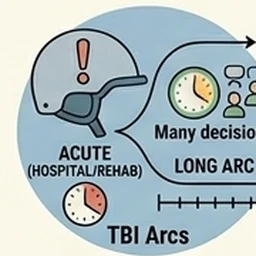
TBI is two very different caregiving stories — the acute hospital + rehab phase that compresses years of decision-making into weeks, and the long arc of recovery (or non-recovery) that can stretch over decades. The family that started in an ICU waiting room becomes, often unexpectedly, the long-term care team. Here's the orientation.
家庭会发生什么变化
Traumatic brain injury reshapes a family along two axes that don't move at the same pace. The acute phase — ICU, then rehab, then home or to a long-term-care facility — happens in days and weeks. Decisions about continuing aggressive treatment, do-not-resuscitate orders, surgery, and tracheostomy + feeding tube placement often arrive before the family understands the prognosis. Once the patient is stable, the long arc begins: cognitive recovery that mostly happens in the first 6-12 months but can continue for years; behavioral and personality changes that families consistently rank as harder than the physical changes; the "you look fine" problem (invisible TBI is real and underestimated by clinicians and friends); and the financial weight of an injury that often hits people at peak earning age. Mild TBI / concussion has its own arc — most people recover in weeks, but a meaningful share develop post-concussion syndrome that lasts months or longer.
需要尽早安排的事情
诊断之后的窗口期,是您的家庭最有余地去搭建后续整个旅程将依靠的结构的时刻。您拖得越久,其中一些事情就越难处理。
- Connection to the Brain Injury Association of your state (find via BIAA). State affiliates run support groups, equipment programs, advocacy, and case-management-style help. The single best first step.
- Documentation of pre-injury baseline. Photos, videos, employment records, work products — anything that shows who the patient was before. Used in rehab + long-term-care + sometimes legal contexts.
- A clinical relationship with a physical-medicine-and-rehabilitation (PM&R) physician (a "physiatrist"), not just a neurologist. PM&R doctors specialize in functional recovery and lead most TBI rehab teams.
- A neuropsychological evaluation 3-6 months post-injury. Documents cognitive strengths + weaknesses, drives the rehab plan, and is often required for school + work accommodations.
- Legal + insurance work: power of attorney (financial + healthcare), Social Security Disability application if work is no longer possible, claims through auto / workers' comp / other accident insurance, special-needs trust consideration if recovery is limited.
- A long-term care plan that doesn't assume the spouse can do all of it indefinitely. Caregiver burnout in TBI is among the highest in any condition; respite + paid care from the beginning is structural, not optional.
最艰难的时刻
家庭描述为最艰难的时刻,往往是没有人提前提醒过他们的那些时刻。知道接下来可能发生什么,并不会让任何一刻变得容易——但能给这些时刻一个名字,并拥有一个在它们发生时能让家人重新聚拢起来的工作空间,会有帮助。
- The acute-phase decisions when prognosis is unclear. Continuing intensive treatment vs. comfort care, surgery vs. waiting, tracheostomy + feeding tube placement — most families have minutes to hours to decide things the patient never discussed with them.
- The behavioral and personality changes. Disinhibition, emotional lability, anger, apathy, perseveration — these are the part of TBI that families consistently describe as hardest. They're not the patient choosing to be different; they're the injury. Education + family therapy help.
- The "invisible TBI" problem. Many TBI survivors look fine and pass cursory cognitive screens but can't hold the job they used to do, can't parent the way they used to, can't manage household finances. Outsiders dismiss it; the family lives with it.
- The plateau or decline. Recovery is not linear, and the rehab gains of the first year don't continue indefinitely. The family's relationship with hope shifts; some find peace, some get stuck.
与此相关的指南
Kintaria 的指南是针对这条照护路径上具体时刻的分步说明。每一份都会在您的工作空间中打开,并根据您的回答进行个性化调整。
- Spouse · 90-day windowYour spouse just had a stroke.
- Hospital · 48-hour windowYour parent was just discharged from a hospital.
- Foundation · One-time setupGet the legal paperwork in order.
- Spouse · OngoingWhen you are the caregiver-spouse.
- Planning · First few weeksYou're ready to bring in a home health aide.
全国性组织与求助热线
这些是业内公认的标准起点。全部免费,并且都是真人接听的求助热线(针对照护者的 AI 电话热线属于另一类——这里指的是接受过该具体疾病培训的人员)。
- National Brain Injury Information Center · 1-800-444-6443
The federal-level TBI organization. NBIIC helpline answers calls from patients + families. State affiliates (linked from BIAA site) run support groups, equipment programs, and case management. Strongest patient + family resource in the category.
For service-member + veteran TBI. Active-duty + post-discharge TBI is a meaningful share of the overall caregiver population; the DOD/VA infrastructure for it is substantial but under-known by families.
Clinician-facing primary, but the patient + family resources are useful. Strong on the science of TBI + the evidence-based treatment guidelines clinicians use; useful when families want to understand what the rehab team is doing.
Founded by snowboarder Kevin Pearce after his TBI. Yoga + meditation programs (in-person + virtual), retreats, community for TBI survivors + families. Different and more wellness-focused than the clinical orgs above.
- CLF Helpline · 866-385-9255
For concussion + chronic traumatic encephalopathy (CTE) — relevant for athletes + service members + post-multiple-concussion patients. CLF helpline, brain bank for research, family support.
Authoritative US government plain-language overview. Free, comprehensive.
Kintaria 工作空间如何提供帮助
Kintaria 是一个为这次诊断即将带来的工作而设计的、平静的、共享的家庭工作空间。用药清单集中在一个地方(这样周末飞回来的第三个兄弟姐妹就不必重新弄清楚有什么变化)。就诊日历是共享的(这样家人就不会重复预约或漏掉风湿科的复诊)。活动记录如实记录谁做了什么(这样主要照护者就不会默默承担一切)。并且工作空间是双语的——患者用自己更习惯的语言阅读,家人用英语阅读——当诊断本身已经让人手足无措时,这一点比人们以为的更重要。
前 500 个创始家庭可享 1 年免费试用。无需信用卡。
关于 Kintaria 是什么(以及不是什么)的说明
Kintaria 不是临床工具,不能替代医学决定,也不能取代traumatic brain injury的照护团队。本页的内容是面向协调照护工作的家庭的导览;具体的临床决定需要由患者的医生作出。整个工作空间中的升级提示对这一界线是诚实的。
本页中的照护术语
您在阅读时可能希望先了解定义的词。每一个都会打开一个独立页面,提供平实的含义说明以及在照护中如何出现。
- Power of attorney — A legal document where one person (the "principal") authorizes another person (the "agent" or "attorney-in-fact") to act on their behalf in financial matters.
- Caregiver burnout — A state of physical, emotional, and mental exhaustion that develops over months or years of caregiving — characterized by chronic fatigue, irritability, isolation, anxiety, depression, sleep disturbance, and worsening physical health.
- Comfort care — A care approach focused entirely on symptom relief and dignity rather than disease treatment.