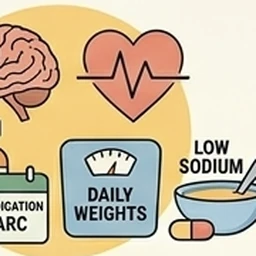
Pag-aalaga sa mahal sa buhay na may heart failure
Caring for someone with heart failure
Heart failure is a chronic-disease management problem more than a single-moment crisis. The work is steady, repetitive, and load-bearing — daily weights, sodium tracking, medication adherence, recognizing decompensation early. The families who do it well prevent most of the hospital readmissions. Here's the orientation.
Ano ang nagbabago para sa pamilya
Heart failure (HF or CHF) doesn't produce a single dramatic before-and-after — it produces a long sequence of small management decisions where the cost of getting it wrong is a 3-day hospital stay every few months. The caregiver becomes a daily monitor: weight at the same time each morning, sodium intake across the day, fluid intake under a target, and an ear for the early symptoms of fluid overload (shortness of breath at night, swollen ankles, sudden 2-3 pound overnight weight gain). The medication regimen is usually 5-8 drugs, often with a diuretic that has to be timed around the patient's day. The relationship reorganizes around the rhythm: the caregiver who didn't want to be the medication tracker becomes one anyway, and the patient who didn't want to be told what to eat has to be. Most heart failure caregivers describe the chronic-disease patience required as the hardest part — there's no resolution, just a year of weeks where the goal is "no readmission this month."
Ano ang dapat ihanda nang maaga
Ang panahon pagkatapos ng diagnosis po ang yugto na pinakamaraming puwedeng gawin ng pamilya para itayo ang istrukturang sasandalan ng natitirang bahagi ng paglalakbay na ito. Habang inaantala po ninyo, lalong nagiging mahirap ang ilan sa mga bagay na ito.
- A daily weight log + a written "if your weight is up X pounds in Y days, call the clinic" plan. Most cardiology teams give a written zone plan (green / yellow / red); if yours hasn't, ask. This is the single highest-leverage caregiver intervention in heart failure.
- A medication list the patient + caregiver + clinician all agree on. Heart failure medications change frequently as the dose is titrated; a stale list causes errors. The shared workspace makes this easier.
- A sodium-tracking habit. Hidden sodium is the hard part — restaurant food, canned soup, bread, deli meat. Most patients tolerate 2,000 mg/day; the cardiology team has the actual target. The first 30 days of learning this matters more than the next year.
- Legal documents while the patient is stable: durable POA, healthcare POA, advance directive. Advanced heart failure brings sudden decompensations; the paperwork should be done before one of those hospitalizations.
- A referral to cardiac rehab if eligible. Cardiac rehab is the most evidence-based intervention for quality of life in heart failure and the most under-prescribed. Ask if it wasn't offered.
- A conversation about goals of care — what the patient wants from the next year. Heart failure has a more predictable late trajectory than most diseases; talking about it early is easier than talking about it during the hospital admission that forces it.
Ang pinakamahihirap na sandali
Ang mga sandali pong inilalarawan ng mga pamilya bilang pinakamahirap ay madalas na yaong walang nagsabi nang maaga sa kanila. Hindi po nagiging madali ang anuman sa mga ito dahil lang alam na ninyo na malamang dumating ang mga ito — pero ang pagkakaroon po ng pangalan para sa mga ito, at ng isang workspace na nagbubuklod muli sa pamilya kapag dumating ang mga ito, ay talagang nakatutulong.
- The first hospital admission for decompensation after a stable period. It's easy to interpret as a setback that "must have a reason"; usually the reason is that heart failure progresses. Reframing this as the disease, not the family's management failure, is the first hard conversation.
- The shift from "still driving, still active" to "needs help with stairs." Heart failure progression is often visible in exertion tolerance more than anything else; the day a familiar walk becomes too much is one families describe as hard.
- The advanced-therapies conversation — LVAD, transplant evaluation, or palliative care. Each requires a high-stakes decision; the conversation is best had with a heart-failure cardiologist (not a general cardiologist) and the family together.
- The decision to stop aggressive treatment and pursue comfort. Advanced heart failure has clear inflection points; most families wish they had asked about hospice earlier than they did.
Mga playbook na kaugnay nito
Ang mga playbook po ng Kintaria ay hakbang-hakbang na gabay para sa mga partikular na sandali na lumalabas sa daloy ng pag-aalaga na ito. Bawat isa po ay bubukas sa loob ng inyong workspace at iaayon sa mga sagot ninyo.
- Hospital · 48-hour windowYour parent was just discharged from a hospital.
- Foundation · One-time setupGet the legal paperwork in order.
- Spouse · OngoingWhen you are the caregiver-spouse.
- Parent · This is real nowYour parent is in the ER for the first time.
- Transition · HospiceYou think your parent may be approaching the end of life.
Mga pambansang organisasyon at helpline
Ito po ang mga organisasyong itinuturing na pamantayang panimulang punto sa larangan. Lahat po ay libre, at lahat ay tunay na helpline na sinasagot ng tao (ang AI-on-the-phone na caregiver line po ay ibang kategorya — dito po ay tao na sinanay sa partikular na kondisyong ito).
- Support Network · 24/7
Educational resources, a caregiver-specific Support Network for connecting with families navigating the same diagnosis, "Rise Above Heart Failure" patient-and-family materials.
Clinician-facing primary, but the patient + caregiver section has condition-specific guides ("Managing Your Heart Failure," nutrition + medication primers).
- 1-888-432-7899
Peer-support organization for heart patients and their families. National network of accredited visitors (patients who have lived through what your loved one is facing), hospital visiting programs, support groups.
Patient-and-family arm of the American College of Cardiology. Plain-language guides, decision tools, condition-specific videos.
Authoritative US government overview. Free, comprehensive, plain-language.
Paano tumutulong ang isang Kintaria workspace
Ang Kintaria po ay isang kalmado at magkasamang workspace ng pamilya na ginawa para sa trabahong sisimulang likhain ng diagnosis na ito. Ang listahan ng gamot ay nasa iisang lugar (para hindi na po kailangang muling pag-aralan ng pangatlong kapatid na lilipad pauwi sa katapusan ng linggo kung ano ang nagbago). Ang kalendaryo ng mga appointment ay magkasama (para hindi po magdoble ang booking ng pamilya o makalimutan ang follow-up sa rheumatology). Ang activity feed ay tapat tungkol sa kung sino ang gumawa ng ano (para hindi po dahan-dahang nagdadala ng lahat ang pangunahing tagapag-alaga). At ang workspace ay bilingual po — ang pasyente ay nakababasa sa wikang mas komportable para sa kanya, ang pamilya ay nakababasa sa Ingles — at ito po ay mas mahalaga kaysa sa inaasahan ng karamihan kapag ang diagnosis mismo ay nakapagpapalito na.
Libreng 1-taong subok para sa unang 500 founding na pamilya. Walang kailangang credit card.
Isang paalala kung ano ang Kintaria (at kung ano ang hindi)
Hindi po klinikal na kasangkapan ang Kintaria, hindi po kapalit ng medikal na desisyon, at hindi po kapalit ng care team para sa heart failure. Ang nilalaman po sa pahinang ito ay para sa mga pamilyang nag-uugnay ng pangangalaga; ang mga tiyak na klinikal na desisyon ay kailangang gawin ng doktor ng pasyente. Ang mga senyales ng pag-escalate sa buong workspace ay tapat tungkol sa hangganang iyon.
Mga termino sa pangangalaga na lumalabas sa pahinang ito
Mga salitang baka po gusto ninyong malaman ang kahulugan habang binabasa ito. Bawat isa po ay bubukas sa sariling pahina na may simpleng paliwanag ng kahulugan at kung paano ito lumalabas sa pangangalaga.
- Palliative care — Specialty care focused on quality of life and symptom relief for people with serious illness.
- Hospice — A type of care for people with a life expectancy of about 6 months or less, focused entirely on comfort rather than cure.
- Power of attorney — A legal document where one person (the "principal") authorizes another person (the "agent" or "attorney-in-fact") to act on their behalf in financial matters.
- Healthcare proxy — A legal document naming a person to make medical decisions if the patient cannot.
- Advance directive — A written document specifying a patient's wishes for end-of-life medical care — typically covering CPR, mechanical ventilation, artificial nutrition, and other interventions when recovery is unlikely.
- Readmission — A return to the hospital within 30 days of discharge.
Tingnan din: lahat ng kondisyon · lahat ng playbook · talasalitaan para sa tagapag-alaga · pambansang direktoryo ng mapagkukunan