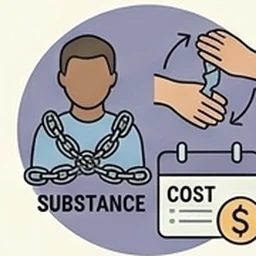
照护患有substance use disorder的亲人
Caring for a family member with substance use disorder
Substance use disorder reshapes a family in ways most caregiver frameworks don't cover. The patient is often resistant to treatment, the medical system isn't built to coordinate with families, and the cost — financial, emotional, and across generations — is unusually high. Here's the orientation, with the harm-reduction reality the field has settled on.
家庭会发生什么变化
Substance use disorder (SUD) — alcohol use disorder, opioid use disorder, stimulant use disorder, and others — is a chronic, relapsing medical condition with disproportionately high family caregiving burden. The family's role is shaped by several patterns that don't fit other chronic diseases. The patient's relationship to treatment is often ambivalent or actively resistant; the "they have to want it" framing is partially true but oversimplified (motivation is itself something treatment helps build). The medical system's coordination with families is weak — addiction medicine is poorly integrated with primary care, mental-health, and emergency medicine in most regions. The harm-reduction reality the field has consolidated around — naloxone in every home with an opioid user, never use alone, fentanyl test strips, medication-for-addiction treatment (MAT) for opioid use disorder — sometimes conflicts with the abstinence-only models families were raised with. The overlap with serious mental illness, with trauma, with chronic pain, and with other chronic diseases is substantial; treatment that addresses only the substance use without the underlying drivers often fails. And the financial + legal + custody consequences often layer on top of the medical reality in ways most families weren't prepared for.
需要尽早安排的事情
诊断之后的窗口期,是您的家庭最有余地去搭建后续整个旅程将依靠的结构的时刻。您拖得越久,其中一些事情就越难处理。
- Naloxone (Narcan) in every home where opioid use is present. Available over-the-counter as a 4mg nasal spray; most insurance covers it; community-distribution programs give it away free. The overdose-reversal medication that saves lives — including in situations where the family didn't know opioids were being used.
- Connection to SAMHSA's 24/7 helpline (1-800-662-4357). Free, confidential, in English + Spanish, doesn't require insurance. Treatment locator, family-resource referrals, crisis support.
- Education about medication-for-addiction treatment (MAT). For opioid use disorder, buprenorphine (Suboxone) and methadone are evidence-based, life-extending treatments that reduce overdose deaths by 50%+. Family understanding + support for MAT — vs. the still-common "you're just trading one drug for another" framing — measurably improves outcomes.
- A Family-to-Family-style program — Al-Anon (for families of people with alcohol use disorder), Nar-Anon (for opioid + other drugs), SMART Recovery Family & Friends. Peer support specifically for family members of someone with SUD. The relief of meeting others who understand the dynamic is structurally important.
- Legal documents while the patient is well enough to sign — durable POA for healthcare and financial decisions, advance directive, sometimes a substance-use-specific advance directive that documents the patient's preferences for future treatment.
- A safety plan that includes financial separation if needed. Joint accounts, shared credit cards, joint mortgages — these can become vectors for financial harm during active use. Separating doesn't mean abandoning; it means protecting the family's ability to keep helping over the long term.
最艰难的时刻
家庭描述为最艰难的时刻,往往是没有人提前提醒过他们的那些时刻。知道接下来可能发生什么,并不会让任何一刻变得容易——但能给这些时刻一个名字,并拥有一个在它们发生时能让家人重新聚拢起来的工作空间,会有帮助。
- An overdose. For opioid use disorder specifically, overdose is often the moment that reshapes the family's relationship with the patient and with the disease. Survival depends on naloxone availability + someone present. Post-overdose is one of the highest-risk periods for re-overdose; treatment access in the first 72 hours matters.
- A relapse after a period of recovery. The shame, the grief, the practical scramble — all real. The medical fact: relapse is part of the chronic-disease pattern of SUD; the question is how the family + the treatment team respond to it. Most evidence supports rapid re-engagement with treatment, not punishment.
- The decision about boundaries vs. continued engagement. "Letting them hit bottom" is an idea that's done real damage; modern addiction medicine doesn't support it. But there are limits to what a family can absorb. Where to draw boundaries is genuinely hard; therapists experienced in family-of-SUD work help.
- When SUD interacts with parenting — custody decisions, child-protective-services involvement, the impact on grandchildren. The intergenerational pattern is real, and breaking it is real work. Family therapy specifically helps; isolated individual treatment for the person with SUD often misses this dimension entirely.
与此相关的指南
Kintaria 的指南是针对这条照护路径上具体时刻的分步说明。每一份都会在您的工作空间中打开,并根据您的回答进行个性化调整。
- Wellness · OngoingWhen you're burning out.
- Spouse · OngoingWhen you are the caregiver-spouse.
- Foundation · One-time setupGet the legal paperwork in order.
- Parent · Financial interventionWhen your parent's bills become a problem.
- Sibling · Inheriting the careYour parent was caring for your sibling — and now they can't.
全国性组织与求助热线
这些是业内公认的标准起点。全部免费,并且都是真人接听的求助热线(针对照护者的 AI 电话热线属于另一类——这里指的是接受过该具体疾病培训的人员)。
- 1-800-662-4357 · 24/7 · English + Spanish
The federal substance-use + mental-health helpline. Free, confidential, no insurance required. Treatment locator (FindTreatment.gov), referrals to family-support programs. The single best first call.
- Meeting Information · 1-888-425-2666
For families + friends of people with alcohol use disorder. Peer-support meetings in person + online, the Family Group Conference Approved literature, sponsor program. The longest-established and most-attended SUD family-support organization.
- 1-800-477-6291
For families + friends of people with substance use issues (opioids, stimulants, marijuana, others). Same model as Al-Anon — peer-support meetings, literature, sponsor program. Local groups across the country and online.
A secular, evidence-based alternative to Al-Anon / Nar-Anon. Uses CRAFT (Community Reinforcement and Family Training) — the most-studied family-side SUD intervention. Online and in-person meetings.
- Parent Helpline · 1-855-378-4373
Family-focused organization specifically. Parent helpline (real people, 24-hour callback), one-to-one coaching with trained parent coaches, peer-support community, harm-reduction resources.
Recovery-community advocacy. Local recovery-community organizations across the country offer peer recovery support that complements clinical treatment; the family connection points are deep.
NIH National Institute on Drug Abuse + National Institute on Alcohol Abuse and Alcoholism family-side resources. Authoritative, plain-language, free.
Kintaria 工作空间如何提供帮助
Kintaria 是一个为这次诊断即将带来的工作而设计的、平静的、共享的家庭工作空间。用药清单集中在一个地方(这样周末飞回来的第三个兄弟姐妹就不必重新弄清楚有什么变化)。就诊日历是共享的(这样家人就不会重复预约或漏掉风湿科的复诊)。活动记录如实记录谁做了什么(这样主要照护者就不会默默承担一切)。并且工作空间是双语的——患者用自己更习惯的语言阅读,家人用英语阅读——当诊断本身已经让人手足无措时,这一点比人们以为的更重要。
前 500 个创始家庭可享 1 年免费试用。无需信用卡。
关于 Kintaria 是什么(以及不是什么)的说明
Kintaria 不是临床工具,不能替代医学决定,也不能取代substance use disorder的照护团队。本页的内容是面向协调照护工作的家庭的导览;具体的临床决定需要由患者的医生作出。整个工作空间中的升级提示对这一界线是诚实的。
本页中的照护术语
您在阅读时可能希望先了解定义的词。每一个都会打开一个独立页面,提供平实的含义说明以及在照护中如何出现。
- Power of attorney — A legal document where one person (the "principal") authorizes another person (the "agent" or "attorney-in-fact") to act on their behalf in financial matters.
- Advance directive — A written document specifying a patient's wishes for end-of-life medical care — typically covering CPR, mechanical ventilation, artificial nutrition, and other interventions when recovery is unlikely.