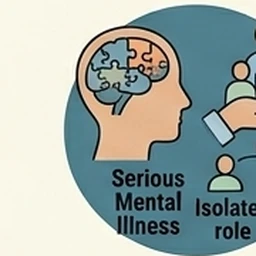
serious mental illnessを抱えるご家族の介護
Caring for a family member with serious mental illness
Serious mental illness — schizophrenia, bipolar I, severe major depression with psychotic features — is one of the most isolating caregiving roles in the US. The patient is often an adult child whose illness emerged in their late teens or twenties, and the family inherits decades of coordination work the medical system was never built to share. Here's the orientation.
家族にとって何が変わるか
Serious mental illness (SMI) reshapes a family along several axes the standard caregiver narrative doesn't cover. The patient is often a younger adult — schizophrenia typically emerges in the late teens or 20s, bipolar I in the 20s — meaning families face decades of caregiving rather than the late-life arc most caregiver resources assume. The medical system rarely sees the family as part of the team: HIPAA and the patient's autonomy rights mean the family is often informed only at hospitalization, sometimes not even then. The patient's relationship with treatment can be inconsistent (the "lack of insight" — anosognosia — that comes with some psychotic disorders is a clinical feature, not the patient being difficult). Housing, employment, benefits, the criminal-legal system, and substance use frequently intersect. And the stigma is real, both externally (housing discrimination, employment discrimination) and within families (the parents-of-an-adult-child-with-SMI cohort is one of the most isolated caregiver populations in the literature). NAMI — the National Alliance on Mental Illness — is the central family organization, and the single most useful first call.
早めに整えておきたいこと
診断後の期間は、これから先の道のり全体が支えにする構造を、ご家族が最もよく整えられるタイミングです。先延ばしにすればするほど、ここに挙げた事柄のいくつかは難しくなっていきます。
- A NAMI Family-to-Family course. 8 weeks, free, taught by trained family-member volunteers. Most attendees describe it as the most useful single thing they did in their caregiving arc. The Family Support Group (an ongoing version) is just as useful for the long term.
- Connection to an assertive community treatment (ACT) team if available in your area. ACT teams (multidisciplinary teams that work with SMI patients in the community) are the most evidence-based model for severe-and-persistent mental illness; under-utilized because they're hard to find. State mental-health authority can locate one.
- Documentation work while cooperation is possible: signed releases for the family to receive clinical information (HIPAA authorization), durable POA for healthcare, possibly a psychiatric advance directive that documents the patient's preferences for future treatment when they're well.
- A relationship with a psychiatrist who specializes in SMI (often a "first-episode psychosis" or "early-onset" specialist if the patient is younger). Care continuity matters more in SMI than almost any other condition; the wrong handoff can disrupt years of stability.
- Benefits + housing setup: SSI/SSDI application, Section 8 if relevant, Medicaid (often the only insurance that covers long-term outpatient psychiatric care), state mental-health-authority case-management enrollment. The benefits navigation is its own job.
- A crisis plan that's written down before crisis. The right phone numbers (988, the patient's case manager, the psychiatrist's on-call, local mobile crisis team, the family's designated decision-maker), the patient's current medications, prior hospitalizations, the things that have worked + the things that haven't. Save in everyone's phone.
もっともつらい瞬間
ご家族がもっともつらかったと語る瞬間は、誰も事前に教えてくれなかった瞬間であることがよくあります。これから起こりうることを知っていても、どの瞬間も楽になるわけではありません。それでも、その瞬間に名前を与えられること、そしてその瞬間が来たときに家族を再び結びつけてくれるワークスペースがあることは、確かに助けになります。
- A first psychotic break or first manic episode. The patient is often someone the family knew completely; the disease that emerges is unfamiliar. The hospitalization is short; the discharge often premature; the family is left to figure out what comes next with very little support.
- Medication non-adherence. Anosognosia (the clinical lack of insight into one's own illness) is common in schizophrenia and means the patient genuinely doesn't experience themselves as ill. Long-acting injectable medications can help; involuntary medication is a fraught legal process; family pressure rarely works long-term.
- A police or criminal-justice encounter. People with SMI are disproportionately likely to interact with police; outcomes range from a calm crisis intervention team encounter to a fatal one. Mobile crisis teams (in regions that have them) are dramatically safer than 911. Build the alternative numbers into the crisis plan.
- The long arc. Unlike most caregiving roles, SMI caregiving often continues for decades with episodic crises rather than a clear trajectory. Caregiver burnout is the rule. The structural answer is respite + support groups + therapy for the caregiver, all started early.
これに対応するプレイブック
Kintaria のプレイブックは、この介護の道のりで実際に出てくる具体的な場面のための、ステップ・バイ・ステップの手引きです。それぞれがあなたのワークスペース内で開き、あなたの回答に応じてパーソナライズされます。
- Adult child · Before the 18th birthdayYou need to set up the special-needs trust and guardianship.
- Adult child with disabilities · Future planningWhen you are the parent-caregiver and you need to plan for after you.
- Wellness · OngoingWhen you're burning out.
- Foundation · One-time setupGet the legal paperwork in order.
- Sibling · Inheriting the careYour parent was caring for your sibling — and now they can't.
全国規模の団体と電話相談窓口
これらは、この分野で標準的な出発点とされている団体です。すべて無料で、すべて実在の担当者が対応する電話相談窓口です(介護者向けの AI 電話相談はまた別のカテゴリーで、ここでは特定の疾患の研修を受けた人を指します)。
- HelpLine · 1-800-950-6264 (text 62640) · Crisis: 988
The central family-side mental-health organization in the US. NAMI HelpLine answers calls from families. Family-to-Family course (8 weeks, free) is the single most-recommended resource. Local affiliates run support groups + advocacy.
- 988 · 24/7
For acute crisis. Free, confidential, doesn't auto-dispatch police. Trained counselors. Can connect to local mobile crisis teams where they exist (a meaningfully safer alternative to 911 for mental-health crises).
- 1-800-662-4357 · 24/7 · English + Spanish
Federal substance-abuse + mental-health services helpline. Free, confidential, doesn't require insurance. Useful when the SMI overlaps with substance use (which it often does).
Policy-focused organization specifically on access to SMI treatment. Strong resources on assisted outpatient treatment (AOT) laws, anosognosia, and the civil-commitment landscape state by state. Useful when the family is navigating involuntary-treatment questions.
Schizophrenia-specific patient + family advocacy. Online community, family-support resources, advocacy on policy that affects people with psychotic disorders.
- Helpline · 1-800-826-3632
For bipolar + severe-depression cohorts. Peer-led support groups across the country, education programs, wellness tools. The bipolar-specific community is the most engaged.
Authoritative US government plain-language overview. Free, comprehensive.
Kintaria のワークスペースがどう役立つか
Kintaria は、この診断がこれから生み出す仕事のために設計された、穏やかで共有可能な家族のワークスペースです。お薬リストは 1 か所にまとまっており、週末に飛行機で帰ってくる 3 番目のきょうだいが「何が変わったか」を一から学び直さずに済みます。診察の予定は共有されていて、家族が予定を重ねたり、リウマチ科のフォローアップを見落としたりしにくくなります。アクティビティの記録は「誰が何をしたか」について正直で、主たる介護者がすべてを黙って抱え込まなくて済みます。そしてワークスペースはバイリンガルです — 患者さまはご自身が楽な言語で読み、ご家族は英語で読みます — 診断そのものですでに頭が回らない状況では、この点は多くの人が想像する以上に重要になります。
創設の最初の 500 ご家族には 1 年間の無料トライアルをご提供します。クレジットカードは不要です。
Kintaria が何であり、何でないかについての一文
Kintaria は臨床ツールではなく、医療上の意思決定の代わりになるものでもなく、serious mental illnessの医療チームの代わりになるものでもありません。このページの内容は、介護を調整するご家族のためのオリエンテーションです。個別の臨床判断は、患者さまの担当医師が行う必要があります。ワークスペース全体で示されるエスカレーションのサインは、その境界について正直に書かれています。
このページに出てくる介護用語
お読みになりながら意味を確認したくなりそうな言葉です。それぞれが独立したページで開き、わかりやすい言葉での意味と、介護の現場でどのように出てくるかを説明します。
- Case manager — A nurse or social worker employed by the hospital whose job is to coordinate care across the system — most importantly, discharge planning.
- Power of attorney — A legal document where one person (the "principal") authorizes another person (the "agent" or "attorney-in-fact") to act on their behalf in financial matters.
- Advance directive — A written document specifying a patient's wishes for end-of-life medical care — typically covering CPR, mechanical ventilation, artificial nutrition, and other interventions when recovery is unlikely.
- HIPAA authorization — A signed form authorizing a healthcare provider to release the patient's information to a named family member or other party.
- Medicaid — Joint federal-state program covering health care for low-income people, including many people with disabilities and many older adults who have spent down their assets.
- Caregiver burnout — A state of physical, emotional, and mental exhaustion that develops over months or years of caregiving — characterized by chronic fatigue, irritability, isolation, anxiety, depression, sleep disturbance, and worsening physical health.
関連リンク: すべての疾患 · すべてのプレイブック · 介護者用語集 · 全国リソース一覧