Cuidando a un ser querido con traumatic brain injury
Caring for someone with a traumatic brain injury
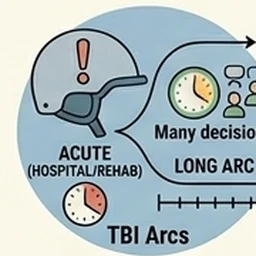
TBI is two very different caregiving stories — the acute hospital + rehab phase that compresses years of decision-making into weeks, and the long arc of recovery (or non-recovery) that can stretch over decades. The family that started in an ICU waiting room becomes, often unexpectedly, the long-term care team. Here's the orientation.
Lo que cambia para la familia
Traumatic brain injury reshapes a family along two axes that don't move at the same pace. The acute phase — ICU, then rehab, then home or to a long-term-care facility — happens in days and weeks. Decisions about continuing aggressive treatment, do-not-resuscitate orders, surgery, and tracheostomy + feeding tube placement often arrive before the family understands the prognosis. Once the patient is stable, the long arc begins: cognitive recovery that mostly happens in the first 6-12 months but can continue for years; behavioral and personality changes that families consistently rank as harder than the physical changes; the "you look fine" problem (invisible TBI is real and underestimated by clinicians and friends); and the financial weight of an injury that often hits people at peak earning age. Mild TBI / concussion has its own arc — most people recover in weeks, but a meaningful share develop post-concussion syndrome that lasts months or longer.
Lo que conviene organizar temprano
La ventana después del diagnóstico es cuando la familia tiene más margen para establecer la estructura sobre la que se apoyará el resto del camino. Mientras más espere, más difícil se vuelve cada uno de estos pasos.
- Connection to the Brain Injury Association of your state (find via BIAA). State affiliates run support groups, equipment programs, advocacy, and case-management-style help. The single best first step.
- Documentation of pre-injury baseline. Photos, videos, employment records, work products — anything that shows who the patient was before. Used in rehab + long-term-care + sometimes legal contexts.
- A clinical relationship with a physical-medicine-and-rehabilitation (PM&R) physician (a "physiatrist"), not just a neurologist. PM&R doctors specialize in functional recovery and lead most TBI rehab teams.
- A neuropsychological evaluation 3-6 months post-injury. Documents cognitive strengths + weaknesses, drives the rehab plan, and is often required for school + work accommodations.
- Legal + insurance work: power of attorney (financial + healthcare), Social Security Disability application if work is no longer possible, claims through auto / workers' comp / other accident insurance, special-needs trust consideration if recovery is limited.
- A long-term care plan that doesn't assume the spouse can do all of it indefinitely. Caregiver burnout in TBI is among the highest in any condition; respite + paid care from the beginning is structural, not optional.
Los momentos más difíciles
Los momentos que las familias describen como los más difíciles suelen ser aquellos sobre los que nadie las advirtió. Saber lo que probablemente viene no hace que ninguno sea fácil — pero tener un nombre para ellos, y un espacio de trabajo que vuelva a unir a la familia cuando ocurren, sí ayuda.
- The acute-phase decisions when prognosis is unclear. Continuing intensive treatment vs. comfort care, surgery vs. waiting, tracheostomy + feeding tube placement — most families have minutes to hours to decide things the patient never discussed with them.
- The behavioral and personality changes. Disinhibition, emotional lability, anger, apathy, perseveration — these are the part of TBI that families consistently describe as hardest. They're not the patient choosing to be different; they're the injury. Education + family therapy help.
- The "invisible TBI" problem. Many TBI survivors look fine and pass cursory cognitive screens but can't hold the job they used to do, can't parent the way they used to, can't manage household finances. Outsiders dismiss it; the family lives with it.
- The plateau or decline. Recovery is not linear, and the rehab gains of the first year don't continue indefinitely. The family's relationship with hope shifts; some find peace, some get stuck.
Planes que se relacionan con esto
Los planes de Kintaria son guías paso a paso para los momentos específicos que aparecen en este recorrido de cuidado. Cada uno se abre en su espacio de trabajo y se personaliza con sus respuestas.
- Spouse · 90-day windowYour spouse just had a stroke.
- Hospital · 48-hour windowYour parent was just discharged from a hospital.
- Foundation · One-time setupGet the legal paperwork in order.
- Spouse · OngoingWhen you are the caregiver-spouse.
- Planning · First few weeksYou're ready to bring in a home health aide.
Organizaciones nacionales y líneas de ayuda
Estas son las organizaciones que el sector considera los puntos de partida estándar. Todas son gratuitas y todas tienen líneas atendidas por personas reales (la línea telefónica de IA para cuidadores es otra categoría — aquí se trata de personas capacitadas en la condición específica).
- National Brain Injury Information Center · 1-800-444-6443
The federal-level TBI organization. NBIIC helpline answers calls from patients + families. State affiliates (linked from BIAA site) run support groups, equipment programs, and case management. Strongest patient + family resource in the category.
For service-member + veteran TBI. Active-duty + post-discharge TBI is a meaningful share of the overall caregiver population; the DOD/VA infrastructure for it is substantial but under-known by families.
Clinician-facing primary, but the patient + family resources are useful. Strong on the science of TBI + the evidence-based treatment guidelines clinicians use; useful when families want to understand what the rehab team is doing.
Founded by snowboarder Kevin Pearce after his TBI. Yoga + meditation programs (in-person + virtual), retreats, community for TBI survivors + families. Different and more wellness-focused than the clinical orgs above.
- CLF Helpline · 866-385-9255
For concussion + chronic traumatic encephalopathy (CTE) — relevant for athletes + service members + post-multiple-concussion patients. CLF helpline, brain bank for research, family support.
Authoritative US government plain-language overview. Free, comprehensive.
Cómo ayuda un espacio Kintaria
Kintaria es un espacio familiar compartido y tranquilo, diseñado para el trabajo que este diagnóstico está por generar. La lista de medicamentos vive en un solo lugar (para que el tercer hermano que vuela el fin de semana no tenga que volver a aprender qué cambió). El calendario de citas es compartido (para que la familia no duplique citas ni pierda el control de seguimiento de reumatología). El historial de actividad es honesto sobre quién hizo qué (para que el cuidador principal no cargue todo en silencio). Y el espacio es bilingüe — el paciente lee en su idioma preferido, la familia lee en inglés — lo cual importa más de lo que la gente espera cuando el diagnóstico mismo ya es desorientador.
Prueba gratuita de 1 año para las primeras 500 familias fundadoras. Sin tarjeta de crédito.
Una nota sobre lo que Kintaria es (y no es)
Kintaria no es una herramienta clínica, no es un sustituto de las decisiones médicas, no reemplaza al equipo de atención de traumatic brain injury. La orientación de esta página es para familias que coordinan el cuidado; las decisiones clínicas específicas las debe tomar el clínico del paciente. Los mensajes de escalada en todo el espacio son honestos sobre ese límite.
Términos de cuidado en esta página
Palabras que quizá quiera tener definidas mientras lee esto. Cada una abre su propia página con el significado en lenguaje sencillo y cómo aparece en el cuidado.
- Power of attorney — A legal document where one person (the "principal") authorizes another person (the "agent" or "attorney-in-fact") to act on their behalf in financial matters.
- Caregiver burnout — A state of physical, emotional, and mental exhaustion that develops over months or years of caregiving — characterized by chronic fatigue, irritability, isolation, anxiety, depression, sleep disturbance, and worsening physical health.
- Comfort care — A care approach focused entirely on symptom relief and dignity rather than disease treatment.
Ver también: todas las condiciones · todos los planes · glosario de cuidado · directorio nacional de recursos