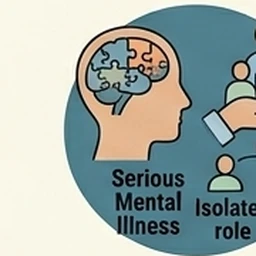
serious mental illness을(를) 앓는 가족을 돌보기
Caring for a family member with serious mental illness
Serious mental illness — schizophrenia, bipolar I, severe major depression with psychotic features — is one of the most isolating caregiving roles in the US. The patient is often an adult child whose illness emerged in their late teens or twenties, and the family inherits decades of coordination work the medical system was never built to share. Here's the orientation.
가족에게 무엇이 달라지는가
Serious mental illness (SMI) reshapes a family along several axes the standard caregiver narrative doesn't cover. The patient is often a younger adult — schizophrenia typically emerges in the late teens or 20s, bipolar I in the 20s — meaning families face decades of caregiving rather than the late-life arc most caregiver resources assume. The medical system rarely sees the family as part of the team: HIPAA and the patient's autonomy rights mean the family is often informed only at hospitalization, sometimes not even then. The patient's relationship with treatment can be inconsistent (the "lack of insight" — anosognosia — that comes with some psychotic disorders is a clinical feature, not the patient being difficult). Housing, employment, benefits, the criminal-legal system, and substance use frequently intersect. And the stigma is real, both externally (housing discrimination, employment discrimination) and within families (the parents-of-an-adult-child-with-SMI cohort is one of the most isolated caregiver populations in the literature). NAMI — the National Alliance on Mental Illness — is the central family organization, and the single most useful first call.
일찍 마련해두어야 할 것들
진단 직후의 시기는 가족이 앞으로의 여정 전체가 의지하게 될 구조를 잡을 수 있는, 가장 여유가 있는 때입니다. 미룰수록 아래의 일들 가운데 일부는 점점 더 어려워집니다.
- A NAMI Family-to-Family course. 8 weeks, free, taught by trained family-member volunteers. Most attendees describe it as the most useful single thing they did in their caregiving arc. The Family Support Group (an ongoing version) is just as useful for the long term.
- Connection to an assertive community treatment (ACT) team if available in your area. ACT teams (multidisciplinary teams that work with SMI patients in the community) are the most evidence-based model for severe-and-persistent mental illness; under-utilized because they're hard to find. State mental-health authority can locate one.
- Documentation work while cooperation is possible: signed releases for the family to receive clinical information (HIPAA authorization), durable POA for healthcare, possibly a psychiatric advance directive that documents the patient's preferences for future treatment when they're well.
- A relationship with a psychiatrist who specializes in SMI (often a "first-episode psychosis" or "early-onset" specialist if the patient is younger). Care continuity matters more in SMI than almost any other condition; the wrong handoff can disrupt years of stability.
- Benefits + housing setup: SSI/SSDI application, Section 8 if relevant, Medicaid (often the only insurance that covers long-term outpatient psychiatric care), state mental-health-authority case-management enrollment. The benefits navigation is its own job.
- A crisis plan that's written down before crisis. The right phone numbers (988, the patient's case manager, the psychiatrist's on-call, local mobile crisis team, the family's designated decision-maker), the patient's current medications, prior hospitalizations, the things that have worked + the things that haven't. Save in everyone's phone.
가장 힘든 순간들
가족들이 가장 힘들었다고 말하는 순간들은 종종 누구도 미리 알려주지 않은 순간들입니다. 무엇이 올 가능성이 있는지 안다고 해서 이 순간들이 쉬워지지는 않습니다 — 그러나 이 순간들에 이름을 붙일 수 있고, 그 순간이 닥쳤을 때 가족을 다시 모이게 해주는 공간이 있다면 도움이 됩니다.
- A first psychotic break or first manic episode. The patient is often someone the family knew completely; the disease that emerges is unfamiliar. The hospitalization is short; the discharge often premature; the family is left to figure out what comes next with very little support.
- Medication non-adherence. Anosognosia (the clinical lack of insight into one's own illness) is common in schizophrenia and means the patient genuinely doesn't experience themselves as ill. Long-acting injectable medications can help; involuntary medication is a fraught legal process; family pressure rarely works long-term.
- A police or criminal-justice encounter. People with SMI are disproportionately likely to interact with police; outcomes range from a calm crisis intervention team encounter to a fatal one. Mobile crisis teams (in regions that have them) are dramatically safer than 911. Build the alternative numbers into the crisis plan.
- The long arc. Unlike most caregiving roles, SMI caregiving often continues for decades with episodic crises rather than a clear trajectory. Caregiver burnout is the rule. The structural answer is respite + support groups + therapy for the caregiver, all started early.
이 질환과 연결되는 플레이북
Kintaria의 플레이북은 이 돌봄 여정에서 실제로 나타나는 구체적인 순간들을 위한 단계별 안내입니다. 각각은 여러분의 워크스페이스에서 열리고, 여러분의 답변에 맞추어 개인화됩니다.
- Adult child · Before the 18th birthdayYou need to set up the special-needs trust and guardianship.
- Adult child with disabilities · Future planningWhen you are the parent-caregiver and you need to plan for after you.
- Wellness · OngoingWhen you're burning out.
- Foundation · One-time setupGet the legal paperwork in order.
- Sibling · Inheriting the careYour parent was caring for your sibling — and now they can't.
전국 단체와 상담 전화
이 단체들은 업계에서 표준적인 출발점으로 여기는 곳들입니다. 모두 무료이며, 모두 실제 사람이 받는 상담 전화입니다(돌봄제공자용 AI 전화 상담은 별개의 범주이며, 여기에서는 해당 질환에 대해 훈련받은 사람을 의미합니다).
- HelpLine · 1-800-950-6264 (text 62640) · Crisis: 988
The central family-side mental-health organization in the US. NAMI HelpLine answers calls from families. Family-to-Family course (8 weeks, free) is the single most-recommended resource. Local affiliates run support groups + advocacy.
- 988 · 24/7
For acute crisis. Free, confidential, doesn't auto-dispatch police. Trained counselors. Can connect to local mobile crisis teams where they exist (a meaningfully safer alternative to 911 for mental-health crises).
- 1-800-662-4357 · 24/7 · English + Spanish
Federal substance-abuse + mental-health services helpline. Free, confidential, doesn't require insurance. Useful when the SMI overlaps with substance use (which it often does).
Policy-focused organization specifically on access to SMI treatment. Strong resources on assisted outpatient treatment (AOT) laws, anosognosia, and the civil-commitment landscape state by state. Useful when the family is navigating involuntary-treatment questions.
Schizophrenia-specific patient + family advocacy. Online community, family-support resources, advocacy on policy that affects people with psychotic disorders.
- Helpline · 1-800-826-3632
For bipolar + severe-depression cohorts. Peer-led support groups across the country, education programs, wellness tools. The bipolar-specific community is the most engaged.
Authoritative US government plain-language overview. Free, comprehensive.
Kintaria 워크스페이스가 어떻게 돕는가
Kintaria는 이 진단이 만들어낼 일들을 위해 설계된, 차분하고 공유되는 가족 워크스페이스입니다. 약 목록은 한 곳에 모여 있어, 주말에 비행기로 오는 셋째 형제자매가 무엇이 바뀌었는지 다시 처음부터 익힐 필요가 없습니다. 진료 일정은 공유되어 있어, 가족이 일정이 겹치거나 류마티스내과 추적 진료를 놓치는 일이 줄어듭니다. 활동 기록은 누가 무엇을 했는지에 대해 정직하기 때문에, 주 돌봄제공자가 모든 일을 조용히 떠안지 않게 됩니다. 그리고 워크스페이스는 이중 언어입니다 — 환자는 자신이 더 편한 언어로 읽고, 가족은 영어로 읽습니다 — 진단 자체가 이미 정신을 어지럽게 만드는 상황에서, 이 점은 사람들이 예상하는 것보다 훨씬 더 중요합니다.
처음 500가족에게 1년 무료 체험을 제공합니다. 신용카드가 필요하지 않습니다.
Kintaria가 무엇인지(그리고 아닌지)에 대한 안내
Kintaria는 임상 도구가 아니며, 의학적 의사결정을 대체하지 않고, serious mental illness 치료팀을 대신하지도 않습니다. 이 페이지의 안내는 돌봄을 조율하는 가족을 위한 것이고, 구체적인 임상 결정은 환자의 담당의가 내려야 합니다. 워크스페이스 곳곳에서 안내되는 escalation 신호는 그 경계에 대해 정직합니다.
이 페이지에서 사용된 돌봄 용어
읽으시면서 뜻을 알고 싶을 수 있는 단어들입니다. 각 단어는 별도의 페이지로 열리며, 쉬운 말로 정의와 돌봄 현장에서 어떻게 등장하는지를 설명합니다.
- Case manager — A nurse or social worker employed by the hospital whose job is to coordinate care across the system — most importantly, discharge planning.
- Power of attorney — A legal document where one person (the "principal") authorizes another person (the "agent" or "attorney-in-fact") to act on their behalf in financial matters.
- Advance directive — A written document specifying a patient's wishes for end-of-life medical care — typically covering CPR, mechanical ventilation, artificial nutrition, and other interventions when recovery is unlikely.
- HIPAA authorization — A signed form authorizing a healthcare provider to release the patient's information to a named family member or other party.
- Medicaid — Joint federal-state program covering health care for low-income people, including many people with disabilities and many older adults who have spent down their assets.
- Caregiver burnout — A state of physical, emotional, and mental exhaustion that develops over months or years of caregiving — characterized by chronic fatigue, irritability, isolation, anxiety, depression, sleep disturbance, and worsening physical health.
함께 보기: 모든 질환 · 모든 플레이북 · 돌봄제공자 용어집 · 전국 자원 디렉터리