kidney disease을(를) 앓는 가족을 돌보기
Caring for someone with kidney disease
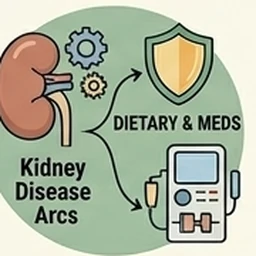
Kidney disease has two distinct caregiving arcs: the slow, mostly invisible chronic-kidney-disease (CKD) years where the work is dietary and medication management, and the much-more-demanding dialysis arc that begins when kidney function drops below ~15%. The decisions families don't see coming — transplant evaluation, dialysis modality, and when to stop — define the trajectory. Here's the orientation.
가족에게 무엇이 달라지는가
Chronic kidney disease (CKD) progresses across five stages over years or decades; most patients with early-stage CKD live a long time with relatively little disruption. Stage 4-5 is when caregiving intensifies: a low-potassium / low-phosphorus / low-sodium diet that affects almost everything the patient eats, a complicated medication regimen (phosphate binders, blood-pressure drugs, sometimes insulin), and the looming decision about renal replacement therapy. Once dialysis starts, the family's week reorganizes around 3-times-a-week 4-hour in-center sessions (or daily home hemo/peritoneal dialysis if that path was chosen). Fatigue on dialysis days is profound. The transplant evaluation is its own multi-month process. And the late-stage decisions — about whether to start dialysis, whether to continue, when to transition to comfort-focused kidney care — are some of the hardest in any chronic disease.
일찍 마련해두어야 할 것들
진단 직후의 시기는 가족이 앞으로의 여정 전체가 의지하게 될 구조를 잡을 수 있는, 가장 여유가 있는 때입니다. 미룰수록 아래의 일들 가운데 일부는 점점 더 어려워집니다.
- Connection to a multidisciplinary CKD clinic if your kidney function is below 30% (eGFR ~30). Outcomes are measurably better with multidisciplinary care (nephrologist + renal dietitian + nurse educator + social worker). Most academic medical centers have one.
- Education about ALL kidney-replacement options BEFORE dialysis becomes urgent — in-center hemo, home hemo, peritoneal dialysis (PD), preemptive transplant, conservative kidney management. The "default" of in-center hemo is rarely the best fit; the choice deserves a real conversation while there's time.
- Transplant evaluation referral. Wait-list time averages 3-7 years depending on region + blood type; preemptive transplant (before dialysis starts) has the best outcomes and requires getting on the list early.
- A relationship with a renal dietitian. The diet is unusual and counterintuitive (low potassium = avoid bananas, tomatoes, oranges; low phosphorus = avoid dairy, dark sodas, processed foods). Generic "healthy eating" advice can hurt.
- Vascular-access planning months before dialysis is needed. An AV fistula takes 2-3 months to mature; starting dialysis with a catheter has worse long-term outcomes.
- Legal documents: durable POA, healthcare POA, advance directive. Advanced kidney disease brings sudden hospitalizations and the kind of late-stage decisions (continue dialysis, withdraw dialysis, transition to hospice) the paperwork should be ready for.
가장 힘든 순간들
가족들이 가장 힘들었다고 말하는 순간들은 종종 누구도 미리 알려주지 않은 순간들입니다. 무엇이 올 가능성이 있는지 안다고 해서 이 순간들이 쉬워지지는 않습니다 — 그러나 이 순간들에 이름을 붙일 수 있고, 그 순간이 닥쳤을 때 가족을 다시 모이게 해주는 공간이 있다면 도움이 됩니다.
- The first dialysis session. The patient often feels worse immediately after (fatigue, low blood pressure, muscle cramps); the family is unprepared for the visible toll, and most caregivers describe the first month as harder than they expected.
- The choice between continued dialysis and stopping. Stopping dialysis is not giving up — it's choosing comfort when continued treatment isn't improving quality of life. Median survival after stopping is 7-10 days, well-managed by hospice. The conversation is hard; families consistently wish they had started it earlier.
- The transplant evaluation result. Being deemed not a candidate (age, cardiac disease, BMI, other comorbidities) closes a door the family had been hoping was open. Even when listed, the wait + the call that may come at any hour reshape the year.
- Cognitive changes on dialysis. Some patients develop "dialysis dementia" or cognitive impairment that worsens between sessions. Families often attribute this to aging rather than the kidney disease itself.
이 질환과 연결되는 플레이북
Kintaria의 플레이북은 이 돌봄 여정에서 실제로 나타나는 구체적인 순간들을 위한 단계별 안내입니다. 각각은 여러분의 워크스페이스에서 열리고, 여러분의 답변에 맞추어 개인화됩니다.
- Foundation · One-time setupGet the legal paperwork in order.
- Hospital · 48-hour windowYour parent was just discharged from a hospital.
- Planning · First few weeksYou're ready to bring in a home health aide.
- Transition · HospiceYou think your parent may be approaching the end of life.
- Spouse · OngoingWhen you are the caregiver-spouse.
전국 단체와 상담 전화
이 단체들은 업계에서 표준적인 출발점으로 여기는 곳들입니다. 모두 무료이며, 모두 실제 사람이 받는 상담 전화입니다(돌봄제공자용 AI 전화 상담은 별개의 범주이며, 여기에서는 해당 질환에 대해 훈련받은 사람을 의미합니다).
- NKF Cares helpline · 1-855-653-2273
The largest patient + family kidney organization. NKF Cares is a peer-mentor program connecting newly-diagnosed patients and families with people who have been through it. Free educational resources, dietitian-reviewed nutrition guides, kidney walks, advocacy.
- Helpline · 1-866-300-2900
Direct financial assistance — health insurance premium grants for dialysis patients (one of the few sources of immigration-status-blind support), transplant medication assistance, emergency grants. Less of a community org and more of a help-with-bills org.
Patient-led advocacy + education. Strong on the kidney-patient experience of policy + insurance; the AAKP Center for Patient Education has condition-specific webinars and a thoughtful kidney-disease 101.
- Hopeline · 1-800-579-1970
Peer support specifically — the Hopeline is staffed by kidney patients (not clinicians). Distinct from NKF Cares in that it leans more emotional + experiential than informational.
For families considering home hemodialysis or peritoneal dialysis. Patient-led, very practical: equipment troubleshooting, training tips, the realities of doing dialysis in a spare bedroom. Under-promoted by in-center programs that profit from in-center treatment.
Authoritative US government plain-language overview. Free, comprehensive, available in English + Spanish.
Kintaria 워크스페이스가 어떻게 돕는가
Kintaria는 이 진단이 만들어낼 일들을 위해 설계된, 차분하고 공유되는 가족 워크스페이스입니다. 약 목록은 한 곳에 모여 있어, 주말에 비행기로 오는 셋째 형제자매가 무엇이 바뀌었는지 다시 처음부터 익힐 필요가 없습니다. 진료 일정은 공유되어 있어, 가족이 일정이 겹치거나 류마티스내과 추적 진료를 놓치는 일이 줄어듭니다. 활동 기록은 누가 무엇을 했는지에 대해 정직하기 때문에, 주 돌봄제공자가 모든 일을 조용히 떠안지 않게 됩니다. 그리고 워크스페이스는 이중 언어입니다 — 환자는 자신이 더 편한 언어로 읽고, 가족은 영어로 읽습니다 — 진단 자체가 이미 정신을 어지럽게 만드는 상황에서, 이 점은 사람들이 예상하는 것보다 훨씬 더 중요합니다.
처음 500가족에게 1년 무료 체험을 제공합니다. 신용카드가 필요하지 않습니다.
Kintaria가 무엇인지(그리고 아닌지)에 대한 안내
Kintaria는 임상 도구가 아니며, 의학적 의사결정을 대체하지 않고, kidney disease 치료팀을 대신하지도 않습니다. 이 페이지의 안내는 돌봄을 조율하는 가족을 위한 것이고, 구체적인 임상 결정은 환자의 담당의가 내려야 합니다. 워크스페이스 곳곳에서 안내되는 escalation 신호는 그 경계에 대해 정직합니다.
이 페이지에서 사용된 돌봄 용어
읽으시면서 뜻을 알고 싶을 수 있는 단어들입니다. 각 단어는 별도의 페이지로 열리며, 쉬운 말로 정의와 돌봄 현장에서 어떻게 등장하는지를 설명합니다.
- Hospice — A type of care for people with a life expectancy of about 6 months or less, focused entirely on comfort rather than cure.
- Power of attorney — A legal document where one person (the "principal") authorizes another person (the "agent" or "attorney-in-fact") to act on their behalf in financial matters.
- Healthcare proxy — A legal document naming a person to make medical decisions if the patient cannot.
- Advance directive — A written document specifying a patient's wishes for end-of-life medical care — typically covering CPR, mechanical ventilation, artificial nutrition, and other interventions when recovery is unlikely.
- eGFR — A calculated estimate of how well the kidneys are filtering, based on serum creatinine, age, and sex.
함께 보기: 모든 질환 · 모든 플레이북 · 돌봄제공자 용어집 · 전국 자원 디렉터리