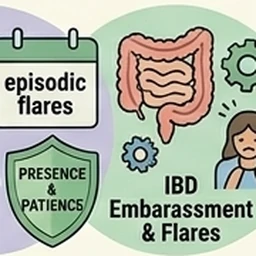
inflammatory bowel diseaseを抱えるご家族の介護
Caring for someone with IBD (Crohn's or ulcerative colitis)
IBD is the chronic illness that families often don't talk about — partly because the symptoms are embarrassing, partly because the disease is unpredictable, partly because most patients are diagnosed young and the caregiver is often a spouse or parent of an adult child. Here's the orientation.
家族にとって何が変わるか
Inflammatory bowel disease — Crohn's disease and ulcerative colitis — is an autoimmune attack on the digestive tract that produces a chronic course with flares and remissions. ~3M Americans have IBD; most are diagnosed between ages 15-35, meaning the family caregiver is often a parent of a teenager or young adult, a spouse, or sometimes a college roommate-turned-partner. The caregiving role is shaped by the disease's peculiarities: bathroom urgency that reshapes daily life and travel; pain that's often dismissed or hidden; medication regimens that include immunosuppressants (with infection risk) and biologics (with infusion logistics and high cost); the surgical track that affects ~70% of Crohn's patients eventually and many UC patients; and the embarrassment-driven isolation that makes IBD different from most chronic diseases. Pediatric-onset IBD adds its own arc: parents become the medical-decision-makers, then the relationship transitions as the patient becomes an adult who manages their own care. Late-stage Crohn's with multiple surgical resections can lead to short bowel syndrome and parenteral nutrition — a level of caregiving most families weren't briefed about at diagnosis.
早めに整えておきたいこと
診断後の期間は、これから先の道のり全体が支えにする構造を、ご家族が最もよく整えられるタイミングです。先延ばしにすればするほど、ここに挙げた事柄のいくつかは難しくなっていきます。
- A gastroenterologist who subspecializes in IBD (not just general GI). Outcomes are measurably better with IBD-specific care; large medical centers often have a dedicated IBD center with multidisciplinary teams.
- Connection to the Crohn's & Colitis Foundation chapter in your area. Patient + family support groups, IBD Help Center, financial assistance for medications, "Camp Oasis" summer camp for kids with IBD.
- A written flare plan from the gastroenterologist. What to do at home, when to call the office, when to go to the ED. Most IBD centers give one; if yours hasn't, ask. Caught-early flares often respond to oral steroid courses; missed flares often mean hospitalization.
- Insurance + financial setup for biologic medications. Most IBD biologics cost $50K-$80K/year; co-pay assistance programs exist for almost every one of them but require active enrollment. The Crohn's & Colitis Foundation's patient-aid team helps families navigate this.
- A nutrition consultation. IBD nutrition is unusual — what works during a flare is different from what works during remission; some patients benefit from elemental diets for flare control; ostomy patients have their own nutritional considerations. A registered dietitian familiar with IBD makes a real difference.
- A family conversation about how visible to make the disease. Most patients oscillate between hiding the disease entirely and being more open. There's no right answer, but the family's posture (treating it as ordinary vs. treating it as shameful) shapes the patient's relationship with it for years.
もっともつらい瞬間
ご家族がもっともつらかったと語る瞬間は、誰も事前に教えてくれなかった瞬間であることがよくあります。これから起こりうることを知っていても、どの瞬間も楽になるわけではありません。それでも、その瞬間に名前を与えられること、そしてその瞬間が来たときに家族を再び結びつけてくれるワークスペースがあることは、確かに助けになります。
- A first severe flare that requires hospitalization. The visible toll — weight loss, dehydration, sometimes blood transfusion — is hard for families to witness. Most flares respond to treatment; reframing as "this is the disease, not the patient losing control" helps.
- The first surgery — often colectomy for UC or bowel resection for Crohn's. The decisions about ileostomy + j-pouch vs. permanent colostomy are heavy and patient-specific. Most patients describe the post-surgical period as significantly better quality of life than they expected.
- Living with an ostomy. The cognitive and emotional adjustment is real and rarely briefed in advance. The United Ostomy Associations of America peer-mentor program is the most useful resource families consistently underuse.
- The transition from pediatric to adult care. For patients diagnosed as kids or teens, the handoff to adult GI happens between 18-22; the parent's role formally ends but rarely actually ends. Most pediatric IBD centers have transition programs; ask about yours.
これに対応するプレイブック
Kintaria のプレイブックは、この介護の道のりで実際に出てくる具体的な場面のための、ステップ・バイ・ステップの手引きです。それぞれがあなたのワークスペース内で開き、あなたの回答に応じてパーソナライズされます。
- Spouse · OngoingWhen you are the caregiver-spouse.
- Adult child · Age 18 to 22Your adult child is aging out of school-based services.
- Foundation · One-time setupGet the legal paperwork in order.
- Wellness · OngoingWhen you're burning out.
- Parent · This is real nowYour parent is in the ER for the first time.
全国規模の団体と電話相談窓口
これらは、この分野で標準的な出発点とされている団体です。すべて無料で、すべて実在の担当者が対応する電話相談窓口です(介護者向けの AI 電話相談はまた別のカテゴリーで、ここでは特定の疾患の研修を受けた人を指します)。
- IBD Help Center · 1-888-694-8872
The patient + family IBD organization in the US. IBD Help Center, support groups in person + online, patient-and-family educational materials, "Power of Two" peer-matching program, Camp Oasis (free camp for kids with IBD).
- Helpline · 1-800-826-0826
For patients with ostomies (a meaningful share of IBD patients after surgery). Peer-visitor program — trained ostomates who visit pre- and post-surgery patients. The single most-recommended ostomy resource by surgeons + nurses.
Patient-led, social-media-native community for younger IBD patients. Strong on the realities of dating, careers, parenting, and college life with IBD — topics the older clinical orgs underweight.
Focused on the experience of Black and Latino IBD patients — historically under-represented in IBD research and care. Patient stories, advocacy, education.
- 1-800-532-5274
Not IBD-exclusive but runs case-management for biologic-treatment access (denials, prior auths, copay issues). Useful when insurance fights are the bottleneck.
Authoritative US government plain-language overview. Free, comprehensive, available in English + Spanish.
Kintaria のワークスペースがどう役立つか
Kintaria は、この診断がこれから生み出す仕事のために設計された、穏やかで共有可能な家族のワークスペースです。お薬リストは 1 か所にまとまっており、週末に飛行機で帰ってくる 3 番目のきょうだいが「何が変わったか」を一から学び直さずに済みます。診察の予定は共有されていて、家族が予定を重ねたり、リウマチ科のフォローアップを見落としたりしにくくなります。アクティビティの記録は「誰が何をしたか」について正直で、主たる介護者がすべてを黙って抱え込まなくて済みます。そしてワークスペースはバイリンガルです — 患者さまはご自身が楽な言語で読み、ご家族は英語で読みます — 診断そのものですでに頭が回らない状況では、この点は多くの人が想像する以上に重要になります。
創設の最初の 500 ご家族には 1 年間の無料トライアルをご提供します。クレジットカードは不要です。
Kintaria が何であり、何でないかについての一文
Kintaria は臨床ツールではなく、医療上の意思決定の代わりになるものでもなく、inflammatory bowel diseaseの医療チームの代わりになるものでもありません。このページの内容は、介護を調整するご家族のためのオリエンテーションです。個別の臨床判断は、患者さまの担当医師が行う必要があります。ワークスペース全体で示されるエスカレーションのサインは、その境界について正直に書かれています。
関連リンク: すべての疾患 · すべてのプレイブック · 介護者用語集 · 全国リソース一覧