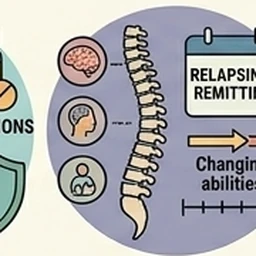
Cuidando a un ser querido con multiple sclerosis
Caring for someone with multiple sclerosis
MS is the most variable of the major chronic neurologic diseases — some patients live decades with mild symptoms, others progress quickly, and the relapsing-remitting course can look stable for years before changing. The work for the family is less about a single crisis and more about adapting to a moving target. Here's the orientation.
Lo que cambia para la familia
Multiple sclerosis is an autoimmune attack on the protective coating of nerve fibers in the brain and spinal cord. Most patients start with relapsing-remitting MS (relapses + recovery) and a meaningful share transition to secondary-progressive MS over time. The disease affects almost every system: motor function (gait, hand use), sensory (numbness, tingling), cognitive (processing speed, memory), bladder + bowel, vision, sexual function, and fatigue — the symptom MS patients consistently rank as most disabling and that families consistently underestimate. The good news: disease-modifying therapies (DMTs) developed in the last 15 years dramatically slow progression and have changed the natural history. The harder news: those DMTs need to be matched to the patient's disease course, monitored with periodic MRIs, and adjusted as the disease evolves. The family role is often less about acute crises and more about steady accommodation as abilities shift.
Lo que conviene organizar temprano
La ventana después del diagnóstico es cuando la familia tiene más margen para establecer la estructura sobre la que se apoyará el resto del camino. Mientras más espere, más difícil se vuelve cada uno de estos pasos.
- A relationship with an MS-specialist neurologist, not a general neurologist. The MS landscape has changed so fast that outcomes are measurably better with subspecialists. The National MS Society maintains a list of partners in care.
- A clear understanding of which DMT the patient is on, what it does, and what to monitor. DMT options have grown to ~20 with very different mechanisms + monitoring requirements; understanding the choice is part of being a useful caregiver.
- Baseline cognitive + neuropsych testing. Cognitive symptoms are common in MS, often subtle, and progress over years. Having a baseline makes future changes easier to recognize.
- A fatigue-management plan. MS fatigue is a unique kind of exhaustion that doesn't respond to rest the way ordinary tiredness does. Pacing, energy budgeting, and (in some cases) modafinil or amantadine help; "just push through" advice can worsen outcomes.
- Home + workplace accommodations early — handrails, raised toilet seat, a chair to sit while cooking, an FMLA conversation with the employer if energy demands are a problem. Easier to set up before they're needed.
- Connection to a local National MS Society chapter for support groups + equipment programs + family-services social work. The MS community is well-organized and generous.
Los momentos más difíciles
Los momentos que las familias describen como los más difíciles suelen ser aquellos sobre los que nadie las advirtió. Saber lo que probablemente viene no hace que ninguno sea fácil — pero tener un nombre para ellos, y un espacio de trabajo que vuelva a unir a la familia cuando ocurren, sí ayuda.
- A relapse after a period of stability. Often hits without warning — new neurologic symptoms over days to weeks. The fear that this is "the start of progression" is one of the heaviest parts of relapsing-remitting MS.
- The conversation about disability accommodation at work or stopping work entirely. MS often affects people in their 30s-50s — peak earning years — and the work decisions reshape family finances in ways most couples weren't planning for.
- The transition from relapsing-remitting to secondary-progressive MS. Often visible only in retrospect; many patients describe the recognition (or the conversation with the neurologist about it) as one of the hardest moments.
- Cognitive changes — particularly when the patient is still high-functioning enough that others don't notice but they themselves know something has shifted. Validation and accommodation matter; dismissal ("you're fine, you remembered the dinner") is corrosive.
Planes que se relacionan con esto
Los planes de Kintaria son guías paso a paso para los momentos específicos que aparecen en este recorrido de cuidado. Cada uno se abre en su espacio de trabajo y se personaliza con sus respuestas.
Organizaciones nacionales y líneas de ayuda
Estas son las organizaciones que el sector considera los puntos de partida estándar. Todas son gratuitas y todas tienen líneas atendidas por personas reales (la línea telefónica de IA para cuidadores es otra categoría — aquí se trata de personas capacitadas en la condición específica).
- MS Navigator · 1-800-344-4867
The largest MS-focused organization in the US. MS Navigators are case-management-style staff who help with everything from finding a neurologist to applying for disability to figuring out accessible vacation rentals. Free, real humans, deeply useful. Local chapters across the country.
- Helpline · 1-800-532-7667
Distinct from the National MS Society — runs an equipment-distribution program (cooling vests for heat-sensitive patients, mobility aids), a peer-support program, and a "My MS Manager" mobile app for symptom + medication tracking.
- Helpline · 1-888-673-6287
Direct financial assistance — emergency grants, cooling-vest program, home-care assistance, transportation grants. The financial-help organization in the MS space.
Wellness-focused MS programs — exercise, nutrition, fatigue management. Family-inclusive weekend programs (free); the closest thing to a "go to one place and learn everything" experience in MS. Patient + care partner attend together.
Federation of 9 MS organizations — the MS Coalition publishes the comprehensive treatment-decision tools the National MS Society + MSAA + others link to. Useful starting point when comparing DMT options.
Authoritative US government plain-language overview. Free, comprehensive.
Cómo ayuda un espacio Kintaria
Kintaria es un espacio familiar compartido y tranquilo, diseñado para el trabajo que este diagnóstico está por generar. La lista de medicamentos vive en un solo lugar (para que el tercer hermano que vuela el fin de semana no tenga que volver a aprender qué cambió). El calendario de citas es compartido (para que la familia no duplique citas ni pierda el control de seguimiento de reumatología). El historial de actividad es honesto sobre quién hizo qué (para que el cuidador principal no cargue todo en silencio). Y el espacio es bilingüe — el paciente lee en su idioma preferido, la familia lee en inglés — lo cual importa más de lo que la gente espera cuando el diagnóstico mismo ya es desorientador.
Prueba gratuita de 1 año para las primeras 500 familias fundadoras. Sin tarjeta de crédito.
Una nota sobre lo que Kintaria es (y no es)
Kintaria no es una herramienta clínica, no es un sustituto de las decisiones médicas, no reemplaza al equipo de atención de multiple sclerosis. La orientación de esta página es para familias que coordinan el cuidado; las decisiones clínicas específicas las debe tomar el clínico del paciente. Los mensajes de escalada en todo el espacio son honestos sobre ese límite.
Ver también: todas las condiciones · todos los planes · glosario de cuidado · directorio nacional de recursos