Cuidando a un ser querido con inflammatory bowel disease
Caring for someone with IBD (Crohn's or ulcerative colitis)
IBD is the chronic illness that families often don't talk about — partly because the symptoms are embarrassing, partly because the disease is unpredictable, partly because most patients are diagnosed young and the caregiver is often a spouse or parent of an adult child. Here's the orientation.
Lo que cambia para la familia
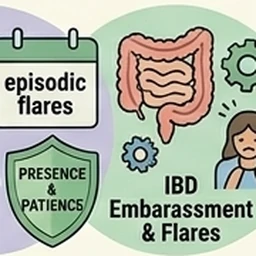
Inflammatory bowel disease — Crohn's disease and ulcerative colitis — is an autoimmune attack on the digestive tract that produces a chronic course with flares and remissions. ~3M Americans have IBD; most are diagnosed between ages 15-35, meaning the family caregiver is often a parent of a teenager or young adult, a spouse, or sometimes a college roommate-turned-partner. The caregiving role is shaped by the disease's peculiarities: bathroom urgency that reshapes daily life and travel; pain that's often dismissed or hidden; medication regimens that include immunosuppressants (with infection risk) and biologics (with infusion logistics and high cost); the surgical track that affects ~70% of Crohn's patients eventually and many UC patients; and the embarrassment-driven isolation that makes IBD different from most chronic diseases. Pediatric-onset IBD adds its own arc: parents become the medical-decision-makers, then the relationship transitions as the patient becomes an adult who manages their own care. Late-stage Crohn's with multiple surgical resections can lead to short bowel syndrome and parenteral nutrition — a level of caregiving most families weren't briefed about at diagnosis.
Lo que conviene organizar temprano
La ventana después del diagnóstico es cuando la familia tiene más margen para establecer la estructura sobre la que se apoyará el resto del camino. Mientras más espere, más difícil se vuelve cada uno de estos pasos.
- A gastroenterologist who subspecializes in IBD (not just general GI). Outcomes are measurably better with IBD-specific care; large medical centers often have a dedicated IBD center with multidisciplinary teams.
- Connection to the Crohn's & Colitis Foundation chapter in your area. Patient + family support groups, IBD Help Center, financial assistance for medications, "Camp Oasis" summer camp for kids with IBD.
- A written flare plan from the gastroenterologist. What to do at home, when to call the office, when to go to the ED. Most IBD centers give one; if yours hasn't, ask. Caught-early flares often respond to oral steroid courses; missed flares often mean hospitalization.
- Insurance + financial setup for biologic medications. Most IBD biologics cost $50K-$80K/year; co-pay assistance programs exist for almost every one of them but require active enrollment. The Crohn's & Colitis Foundation's patient-aid team helps families navigate this.
- A nutrition consultation. IBD nutrition is unusual — what works during a flare is different from what works during remission; some patients benefit from elemental diets for flare control; ostomy patients have their own nutritional considerations. A registered dietitian familiar with IBD makes a real difference.
- A family conversation about how visible to make the disease. Most patients oscillate between hiding the disease entirely and being more open. There's no right answer, but the family's posture (treating it as ordinary vs. treating it as shameful) shapes the patient's relationship with it for years.
Los momentos más difíciles
Los momentos que las familias describen como los más difíciles suelen ser aquellos sobre los que nadie las advirtió. Saber lo que probablemente viene no hace que ninguno sea fácil — pero tener un nombre para ellos, y un espacio de trabajo que vuelva a unir a la familia cuando ocurren, sí ayuda.
- A first severe flare that requires hospitalization. The visible toll — weight loss, dehydration, sometimes blood transfusion — is hard for families to witness. Most flares respond to treatment; reframing as "this is the disease, not the patient losing control" helps.
- The first surgery — often colectomy for UC or bowel resection for Crohn's. The decisions about ileostomy + j-pouch vs. permanent colostomy are heavy and patient-specific. Most patients describe the post-surgical period as significantly better quality of life than they expected.
- Living with an ostomy. The cognitive and emotional adjustment is real and rarely briefed in advance. The United Ostomy Associations of America peer-mentor program is the most useful resource families consistently underuse.
- The transition from pediatric to adult care. For patients diagnosed as kids or teens, the handoff to adult GI happens between 18-22; the parent's role formally ends but rarely actually ends. Most pediatric IBD centers have transition programs; ask about yours.
Planes que se relacionan con esto
Los planes de Kintaria son guías paso a paso para los momentos específicos que aparecen en este recorrido de cuidado. Cada uno se abre en su espacio de trabajo y se personaliza con sus respuestas.
- Spouse · OngoingWhen you are the caregiver-spouse.
- Adult child · Age 18 to 22Your adult child is aging out of school-based services.
- Foundation · One-time setupGet the legal paperwork in order.
- Wellness · OngoingWhen you're burning out.
- Parent · This is real nowYour parent is in the ER for the first time.
Organizaciones nacionales y líneas de ayuda
Estas son las organizaciones que el sector considera los puntos de partida estándar. Todas son gratuitas y todas tienen líneas atendidas por personas reales (la línea telefónica de IA para cuidadores es otra categoría — aquí se trata de personas capacitadas en la condición específica).
- IBD Help Center · 1-888-694-8872
The patient + family IBD organization in the US. IBD Help Center, support groups in person + online, patient-and-family educational materials, "Power of Two" peer-matching program, Camp Oasis (free camp for kids with IBD).
- Helpline · 1-800-826-0826
For patients with ostomies (a meaningful share of IBD patients after surgery). Peer-visitor program — trained ostomates who visit pre- and post-surgery patients. The single most-recommended ostomy resource by surgeons + nurses.
Patient-led, social-media-native community for younger IBD patients. Strong on the realities of dating, careers, parenting, and college life with IBD — topics the older clinical orgs underweight.
Focused on the experience of Black and Latino IBD patients — historically under-represented in IBD research and care. Patient stories, advocacy, education.
- 1-800-532-5274
Not IBD-exclusive but runs case-management for biologic-treatment access (denials, prior auths, copay issues). Useful when insurance fights are the bottleneck.
Authoritative US government plain-language overview. Free, comprehensive, available in English + Spanish.
Cómo ayuda un espacio Kintaria
Kintaria es un espacio familiar compartido y tranquilo, diseñado para el trabajo que este diagnóstico está por generar. La lista de medicamentos vive en un solo lugar (para que el tercer hermano que vuela el fin de semana no tenga que volver a aprender qué cambió). El calendario de citas es compartido (para que la familia no duplique citas ni pierda el control de seguimiento de reumatología). El historial de actividad es honesto sobre quién hizo qué (para que el cuidador principal no cargue todo en silencio). Y el espacio es bilingüe — el paciente lee en su idioma preferido, la familia lee en inglés — lo cual importa más de lo que la gente espera cuando el diagnóstico mismo ya es desorientador.
Prueba gratuita de 1 año para las primeras 500 familias fundadoras. Sin tarjeta de crédito.
Una nota sobre lo que Kintaria es (y no es)
Kintaria no es una herramienta clínica, no es un sustituto de las decisiones médicas, no reemplaza al equipo de atención de inflammatory bowel disease. La orientación de esta página es para familias que coordinan el cuidado; las decisiones clínicas específicas las debe tomar el clínico del paciente. Los mensajes de escalada en todo el espacio son honestos sobre ese límite.
Ver también: todas las condiciones · todos los planes · glosario de cuidado · directorio nacional de recursos