Caring for a loved one with heart failure
Caring for someone with heart failure
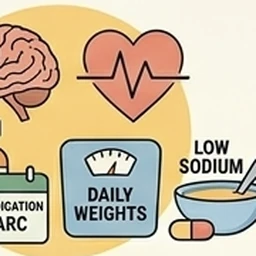
Heart failure is a chronic-disease management problem more than a single-moment crisis. The work is steady, repetitive, and load-bearing — daily weights, sodium tracking, medication adherence, recognizing decompensation early. The families who do it well prevent most of the hospital readmissions. Here's the orientation.
What changes for the family
Heart failure (HF or CHF) doesn't produce a single dramatic before-and-after — it produces a long sequence of small management decisions where the cost of getting it wrong is a 3-day hospital stay every few months. The caregiver becomes a daily monitor: weight at the same time each morning, sodium intake across the day, fluid intake under a target, and an ear for the early symptoms of fluid overload (shortness of breath at night, swollen ankles, sudden 2-3 pound overnight weight gain). The medication regimen is usually 5-8 drugs, often with a diuretic that has to be timed around the patient's day. The relationship reorganizes around the rhythm: the caregiver who didn't want to be the medication tracker becomes one anyway, and the patient who didn't want to be told what to eat has to be. Most heart failure caregivers describe the chronic-disease patience required as the hardest part — there's no resolution, just a year of weeks where the goal is "no readmission this month."
What to set up early
The window after diagnosis is when families have the most leverage to set the structure that the rest of the journey will lean on. The longer you wait, the harder some of these get.
- A daily weight log + a written "if your weight is up X pounds in Y days, call the clinic" plan. Most cardiology teams give a written zone plan (green / yellow / red); if yours hasn't, ask. This is the single highest-leverage caregiver intervention in heart failure.
- A medication list the patient + caregiver + clinician all agree on. Heart failure medications change frequently as the dose is titrated; a stale list causes errors. The shared workspace makes this easier.
- A sodium-tracking habit. Hidden sodium is the hard part — restaurant food, canned soup, bread, deli meat. Most patients tolerate 2,000 mg/day; the cardiology team has the actual target. The first 30 days of learning this matters more than the next year.
- Legal documents while the patient is stable: durable POA, healthcare POA, advance directive. Advanced heart failure brings sudden decompensations; the paperwork should be done before one of those hospitalizations.
- A referral to cardiac rehab if eligible. Cardiac rehab is the most evidence-based intervention for quality of life in heart failure and the most under-prescribed. Ask if it wasn't offered.
- A conversation about goals of care — what the patient wants from the next year. Heart failure has a more predictable late trajectory than most diseases; talking about it early is easier than talking about it during the hospital admission that forces it.
The hardest moments
The moments families describe as the most difficult are often the ones nobody warned them about. Knowing what's likely coming doesn't make any of these easy — but having language for them, and a workspace to bring the family back together when they happen, helps.
- The first hospital admission for decompensation after a stable period. It's easy to interpret as a setback that "must have a reason"; usually the reason is that heart failure progresses. Reframing this as the disease, not the family's management failure, is the first hard conversation.
- The shift from "still driving, still active" to "needs help with stairs." Heart failure progression is often visible in exertion tolerance more than anything else; the day a familiar walk becomes too much is one families describe as hard.
- The advanced-therapies conversation — LVAD, transplant evaluation, or palliative care. Each requires a high-stakes decision; the conversation is best had with a heart-failure cardiologist (not a general cardiologist) and the family together.
- The decision to stop aggressive treatment and pursue comfort. Advanced heart failure has clear inflection points; most families wish they had asked about hospice earlier than they did.
Playbooks that map to this
Kintaria's playbooks are step-by-step for the specific moments that show up in this caregiving arc. Each one opens in your workspace and personalizes from your answers.
- Hospital · 48-hour windowYour parent was just discharged from a hospital.
- Foundation · One-time setupGet the legal paperwork in order.
- Spouse · OngoingWhen you are the caregiver-spouse.
- Parent · This is real nowYour parent is in the ER for the first time.
- Transition · HospiceYou think your parent may be approaching the end of life.
National organizations + helplines
These are the organizations the field considers the standard starting points. All free, all real human helplines (the AI-on-the- phone caregiver line is a different category — this is people trained in the specific condition).
- Support Network · 24/7
Educational resources, a caregiver-specific Support Network for connecting with families navigating the same diagnosis, "Rise Above Heart Failure" patient-and-family materials.
Clinician-facing primary, but the patient + caregiver section has condition-specific guides ("Managing Your Heart Failure," nutrition + medication primers).
- 1-888-432-7899
Peer-support organization for heart patients and their families. National network of accredited visitors (patients who have lived through what your loved one is facing), hospital visiting programs, support groups.
Patient-and-family arm of the American College of Cardiology. Plain-language guides, decision tools, condition-specific videos.
Authoritative US government overview. Free, comprehensive, plain-language.
How a Kintaria workspace helps
Kintaria is a calm, shared family workspace built for the work this diagnosis is about to create. The medication list lives in one place (so the third sibling who flies in for the weekend doesn't have to re-learn what changed). The appointment calendar is shared (so the family doesn't double-book or miss the rheumatology follow-up). The activity feed is honest about who did what (so the primary caregiver isn't silently carrying everything). And the workspace is bilingual — patient reads in their preferred language, family reads in English — which matters more than people expect when the diagnosis itself is already disorienting.
Free 1-year trial for the first 500 founding families. No credit card.
A note on what Kintaria is (and is not)
Kintaria is not a clinical tool, not a medical-decision substitute, not a replacement for the heart failure care team. The orientation on this page is for families coordinating care; specific clinical decisions need the patient's clinician. The escalation cues throughout the workspace are honest about that boundary.
Caregiver terms on this page
Words you might want defined while reading this. Each opens its own page with the plain-language meaning + how it shows up in caregiving.
- Palliative care — Specialty care focused on quality of life and symptom relief for people with serious illness.
- Hospice — A type of care for people with a life expectancy of about 6 months or less, focused entirely on comfort rather than cure.
- Power of attorney — A legal document where one person (the "principal") authorizes another person (the "agent" or "attorney-in-fact") to act on their behalf in financial matters.
- Healthcare proxy — A legal document naming a person to make medical decisions if the patient cannot.
- Advance directive — A written document specifying a patient's wishes for end-of-life medical care — typically covering CPR, mechanical ventilation, artificial nutrition, and other interventions when recovery is unlikely.
- Readmission — A return to the hospital within 30 days of discharge.
See also: all conditions · all playbooks · caregiver glossary · national resources directory