What changed for caregivers this week — June 8, 2026
Fraud enforcement is reshaping the home-based care landscape faster than most families realize — and this week, the consequences landed in Ohio, Nevada, and Washington simultaneously.
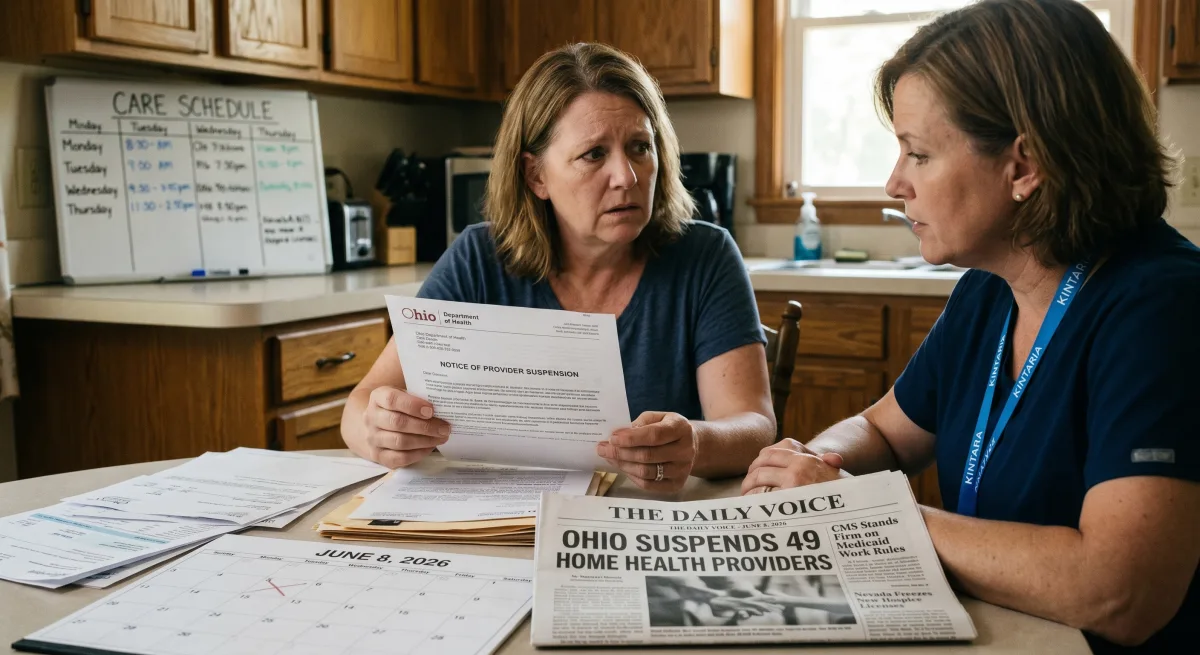
Ohio suspended 49 home health providers, and families may not know their agency is on the list
The Ohio Department of Medicaid suspended 49 home health providers this week as part of the broader federal crackdown on Medicaid-funded home care fraud. The suspensions are immediate — meaning agencies on the list cannot bill Medicaid while the investigation proceeds — and they are part of a coordinated DOJ-state partnership announced Thursday that is explicitly designed to be replicated in other states. Ohio is the pilot. More states are coming.
For families currently using a home health agency in Ohio — or in any state where this enforcement pattern is spreading — the practical risk is the same one that surfaced with hospice payment suspensions last week: a provider under a payment suspension faces immediate cash flow pressure, and that pressure shows up as reduced hours, staffing gaps, or a phone call saying services are being paused. Families are rarely notified proactively. The Ohio Medicaid provider list is public, and it is worth checking whether an agency a family relies on appears on it. That is not a paranoid step — it is the same due diligence a family would apply to any other essential service.
CMS is not backing down on Medicaid work rules, and the home care industry is alarmed
Following the June 1 interim final rule imposing an 80-hour-per-month community engagement requirement on certain adult Medicaid beneficiaries, CMS has signaled it will not retreat despite significant pushback from home care industry groups. The concern from providers is specific: some of the adults subject to the work requirement are the same adults providing unpaid or low-wage care to family members — and the exemption for family caregivers, while written into the rule, depends entirely on how states implement it.
As noted in last week's digest, the public comment window on this rule runs through July 31. The implementation details being settled right now — what documentation states require to claim the caregiver exemption, what languages those materials are issued in, what the appeals process looks like — will determine whether the exemption is functional or theoretical. Home care organizations are submitting formal comments. Families who want their experience on the record can submit comments directly at regulations.gov. The comment process is not a formality; it is the mechanism by which implementation details get changed before they harden into state policy.
Nevada froze new hospice licenses and Medicaid enrollment — and the VITAS CEO called it disappointing
Nevada became the latest state to act on hospice fraud concerns, implementing a moratorium on new hospice and home health licenses and new Medicaid enrollments for those provider types. The move follows CMS's national moratorium on home health and hospice enrollment, which VITAS Healthcare CEO Joel Wherley described this week as "disappointing" — the word a large legitimate operator uses when blunt enforcement tools designed to stop fraud also constrain the providers doing the work correctly.
For families in Nevada who are beginning to research hospice options for a parent or spouse, the moratorium means the pool of licensed providers is fixed for now — no new entrants while the freeze holds. That is not necessarily a crisis, but it does mean families have less flexibility to shop around, and it puts more weight on the quality of providers already in the market. The pattern worth watching: Texas, Ohio, and Nevada are all seeing aggressive enforcement action within the same two-week window. The DOJ-state partnership announced this week is the connective tissue. Families in any state should treat hospice provider vetting — asking directly about open regulatory disputes, payment suspensions, or enrollment holds — as a standard part of the selection conversation, not an awkward one.
Masonicare's light therapy pilot is a small signal about where memory care is heading
Connecticut-based nonprofit Masonicare announced this week that it is piloting light therapy and expanding staff training as part of a broader push toward nonpharmacological approaches in memory care. The intergenerational programming component — structured contact between residents and younger people — is the piece with the strongest research backing for reducing behavioral symptoms and social withdrawal in people living with dementia.
For families with a parent in memory care, or evaluating memory care communities, this is worth knowing as a category signal rather than a Masonicare-specific endorsement. The question to ask any memory care community is not whether they have a dementia program — every community will say yes — but what specific nonpharmacological interventions are built into the daily schedule, how staff are trained to deliver them, and what the staffing ratio looks like on evenings and weekends when programming typically thins out. A community piloting light therapy and investing in staff training is making a different set of bets than one relying primarily on medication management. Those bets show up in day-to-day quality of life for residents, and they are visible if families know to look for them.
The Caregiving Newsroom is published weekly on Monday morning. If a story below should have been on this list, or one shouldn't have been, reply to this post by email — we read everything.