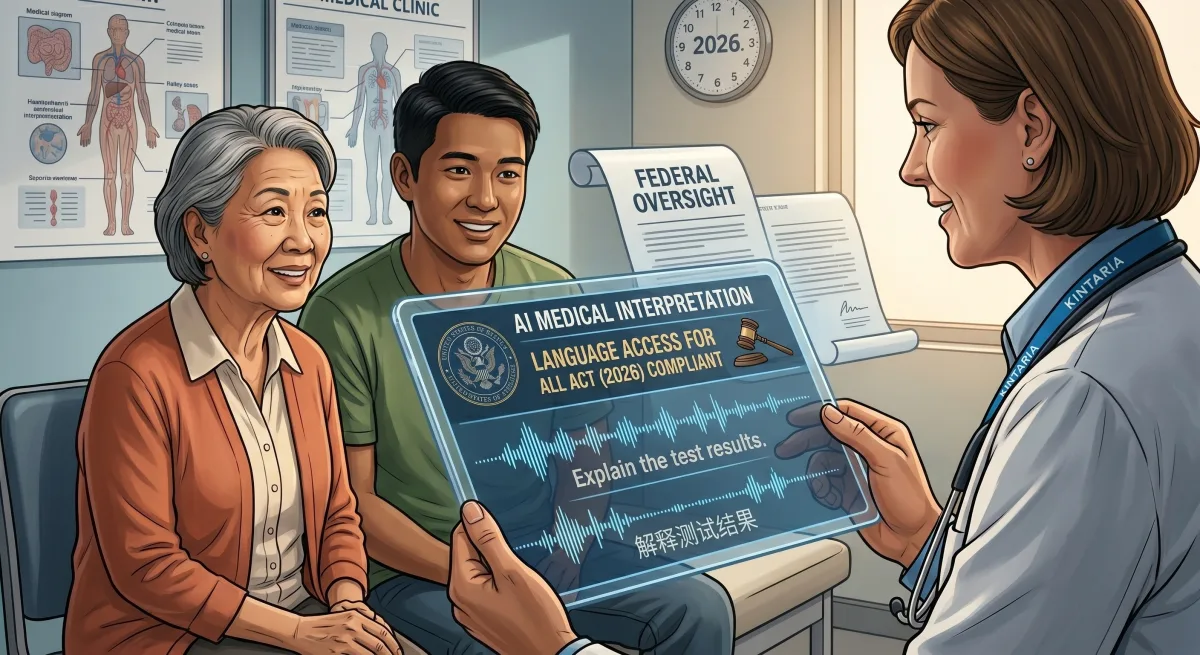
Two things happened in healthcare language-access policy this year that deserve more attention than they're getting. The first was the SPEAK Act, signed into law on February 3, which extends meaningful-language-access requirements to telehealth — closing a gap that opened during the COVID-era telehealth expansion when in-person interpreter requirements quietly stopped applying to video visits. The second is the Language Access for All Act of 2026, introduced this spring, which would formalize language access as a legal requirement across health systems with explicit AI-translation oversight and measurable performance standards.
The Language Access Act isn't law yet. It probably won't pass in its current form. But the policy direction it represents — AI translation under federal oversight, not banned, not unregulated, but actively measured against safety benchmarks — is the direction this whole policy area is moving. Worth understanding now, while the framing is still being set.
The framework families have, today
Two pieces of existing federal law set the floor:
Title VI of the Civil Rights Act of 1964, as interpreted by the 1974 Supreme Court decision in LAU v. Nichols, requires recipients of federal funds (which is essentially every hospital, every clinic that accepts Medicare or Medicaid, every Federally Qualified Health Center) to take reasonable steps to provide meaningful access for people with limited English proficiency.
Section 1557 of the Affordable Care Act, last fully revised in 2024, operationalizes the Title VI obligation: qualified interpreters at no cost to the patient, written notices translated into the 15 most-common non-English languages in the state, non-discrimination notices in multiple languages on websites and in physical locations, and a hard prohibition on requiring patients to bring their own interpreter or using minor children as interpreters.
This is a substantial framework. It is genuinely better than the framework in most of the world. A Spanish-dominant or Mandarin-dominant patient walking into a US hospital in 2026 is entitled to — and in most circumstances actually receives — a phone interpreter, an in-person interpreter for complex visits, translated discharge instructions, and translated consent forms.
What the framework doesn't say much about is AI.
What the SPEAK Act actually does
The SPEAK Act (Supporting Patient Education And Knowledge Act, signed February 3, 2026) is narrower than its name suggests. The specific gap it closes: many telehealth providers had treated the COVID-era telehealth expansion as exempt from in-person language-access standards. The SPEAK Act says no — telehealth visits are subject to the same interpreter-access obligations as in-person visits, and providers that don't deliver them are exposed to the same Title VI / Section 1557 enforcement risk.
What the SPEAK Act doesn't do: it doesn't address AI translation directly. It's about the obligation, not the mechanism. A telehealth provider can satisfy SPEAK Act requirements by routing to a live human interpreter via phone or video; the law is silent on whether AI-mediated translation can satisfy the obligation in any context.
Practical effect for families: if your parent had a telehealth follow-up canceled or shortened because "we don't have a Spanish interpreter for video visits today," that's now a stronger Title VI / 1557 violation than it was six months ago. File the complaint with HHS Office for Civil Rights; cite the SPEAK Act.
What the Language Access Act would actually do
The Language Access for All Act of 2026 is a much broader proposed framework. Three substantive changes it would introduce:
1. Performance standards for language access. Rather than just requiring "reasonable steps" (the Title VI standard) or "qualified interpreters" (the Section 1557 standard), the Act would establish measurable performance benchmarks: response time to interpreter requests, accuracy thresholds for translated written materials, equity metrics across language populations served. The shift from "you must try" to "you must hit these numbers" is significant.
2. Explicit AI-translation oversight. The Act would, for the first time in federal healthcare regulation, name AI translation as a specific category requiring oversight. It would not ban AI translation. It would not require it. It would require that AI-translation use be disclosed to patients, that AI-translation outputs in clinical contexts be subject to accuracy testing, and that healthcare entities maintain records of when AI translation was used vs. when a human interpreter was used. The disclosure obligation is the change that most affects what families actually see.
3. Federal funding tied to compliance. Like Section 1557, the Act's enforcement would partly run through the federal-funding lever — non-compliant providers risk Medicare and Medicaid participation. Unlike Section 1557, the Act would also establish a private right of action for patients harmed by language-access failures, including AI-translation failures. This is the part most likely to be stripped or weakened in committee; private rights of action are politically expensive.
The bill has Senate and House sponsors and a 2026 committee referral. Realistic odds of passage as introduced: low. Realistic odds of the AI-translation-oversight piece showing up in a different bill that does pass: meaningfully higher. This policy area is in motion.
What the research actually says about AI medical translation
The reason the AI-oversight piece in the Act is the substantive change, rather than a feature: the peer-reviewed literature on AI medical translation in 2026 is much more cautious than the consumer-product marketing suggests.
A recent review of the legal, ethical, and policy challenges of AI translation tools in healthcare flags three structural risks: (1) accuracy gaps in lower-diffusion languages (the model is trained on more Spanish than Vietnamese, more Mandarin than Tagalog; the accuracy curve follows training-corpus size, with predictable failure modes for the languages most-needed by LEP populations); (2) loss of cultural and figurative nuance — medical decisions often depend on understanding what a patient means not just what they literally said; and (3) a liability vacuum — when AI translation produces a clinical error, the patient, the clinician, the AI vendor, and the hospital all have plausible deniability, and no current framework cleanly assigns the duty.
A parallel paper on the structural risks of AI-mediated medical interpreting reaches a similar conclusion from a different angle: the "good enough most of the time" performance of current AI translation in clinical contexts produces a specific failure mode — clinicians stop double-checking, because the failures are infrequent and look subtle, exactly until one of them produces a serious mistake.
Both papers converge on the same recommendation: AI translation has a real role to play, but as augmentation to human interpretation in high-stakes settings, not as substitution. The Language Access Act's "oversight + disclosure" framing aligns with this consensus; outright bans of AI translation do not.
The bridge-not-replacement design choice
Across software products in the family-caregiving space — and this is a frame we've used in our bilingual-workspace work — the right design posture for AI translation is what the research recommends: the original-language text stays the canonical record, the translated version sits side-by-side, the user can see both, and the AI's role is to lower the friction of comprehension without owning the meaning.
In practice this looks like: a Vietnamese-speaking grandmother reads her after-visit summary in Vietnamese on her phone. Her American-raised daughter reads the same summary in English on hers. The clinician's original English text is preserved as the canonical record. If there's a discrepancy or a confusion, both family members can compare both versions. Nobody is depending on a translation that erases the source.
This is harder to build than "translate everything to one language for everyone." It's also the design the research literature, and now apparently federal policy, is converging on as the right default for AI in language-access contexts.
What families can do this year, regardless of whether the Act passes
The Act may not pass in 2026. The framework it represents is going to land in healthcare regulation one way or another over the next 2-3 years — through SPEAK-Act-style narrower bills, through Section 1557 rulemaking updates, through state-level legislation in California, New York, Texas, and Illinois that's already in motion (covered in our state AI bills wave essay).
Three things bilingual families can do today:
1. Use the right to a phone interpreter, every time. Title VI applies to every clinical encounter and to phone calls placed to the provider's office. You can call the cardiology office and ask for a phone interpreter; the office is supposed to provide one at no cost. Many family caregivers don't know this, and the office staff sometimes don't either. Insist when you have to. The expansion under the SPEAK Act explicitly covers telehealth visits.
2. Ask whether AI translation is being used. If a clinician is reading you an "interpreted" message that came back from an AI tool, you're entitled to know — not just under the proposed Language Access Act framework, but as a matter of informed-consent practice today. Asking is fine. "Is this human-interpreted or AI-translated?" gets a real answer more often than caregivers expect.
3. Document the language-access gap. Keep notes on encounters where translation was inadequate, where the AI translation missed something important, where the provider's office couldn't reach an interpreter promptly. This is the documentation that supports both individual complaints (to HHS Office for Civil Rights) and the policy-pressure case for closing the gap. The 240+ AI-in-healthcare bills moving in state legislatures right now are largely driven by exactly this kind of patient documentation.
What to watch in the next quarter
Three items worth tracking, in order of likely impact:
Federal-level Section 1557 rulemaking. HHS has been signaling additional Section 1557 guidance specifically on AI use in covered entities. The guidance probably won't establish performance benchmarks (that requires legislation), but it would clarify which AI uses trigger disclosure obligations under existing law. Could land any time between Q3 2026 and early 2027.
The first Language Access Act committee hearing. If the bill gets a hearing, the witness list will show whose framing is in play — patient-advocacy organizations? AI vendors? Hospital systems? The witness list is the political signal.
State-level laws that beat the federal bill. California, Illinois, and New York all have state legislation that would extend AI-translation oversight in healthcare contexts at the state level. Whichever state ships the first enforceable rule will set the de facto template that other states copy from. State enforcement is also more visible to families than federal enforcement; the first state Attorney General action against a healthcare provider for AI-translation-related harm will be a more useful precedent than any federal court ruling for the next two years.
For now, the framework that exists is the framework families have to use. The legal tools are real even before the proposed expansion. The AI-translation oversight piece is coming — slowly, imperfectly, and almost certainly through a different bill than the one currently introduced. The direction of travel is what matters.