traumatic brain injury을(를) 앓는 가족을 돌보기
Caring for someone with a traumatic brain injury
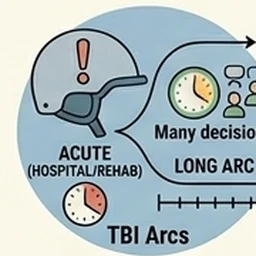
TBI is two very different caregiving stories — the acute hospital + rehab phase that compresses years of decision-making into weeks, and the long arc of recovery (or non-recovery) that can stretch over decades. The family that started in an ICU waiting room becomes, often unexpectedly, the long-term care team. Here's the orientation.
가족에게 무엇이 달라지는가
Traumatic brain injury reshapes a family along two axes that don't move at the same pace. The acute phase — ICU, then rehab, then home or to a long-term-care facility — happens in days and weeks. Decisions about continuing aggressive treatment, do-not-resuscitate orders, surgery, and tracheostomy + feeding tube placement often arrive before the family understands the prognosis. Once the patient is stable, the long arc begins: cognitive recovery that mostly happens in the first 6-12 months but can continue for years; behavioral and personality changes that families consistently rank as harder than the physical changes; the "you look fine" problem (invisible TBI is real and underestimated by clinicians and friends); and the financial weight of an injury that often hits people at peak earning age. Mild TBI / concussion has its own arc — most people recover in weeks, but a meaningful share develop post-concussion syndrome that lasts months or longer.
일찍 마련해두어야 할 것들
진단 직후의 시기는 가족이 앞으로의 여정 전체가 의지하게 될 구조를 잡을 수 있는, 가장 여유가 있는 때입니다. 미룰수록 아래의 일들 가운데 일부는 점점 더 어려워집니다.
- Connection to the Brain Injury Association of your state (find via BIAA). State affiliates run support groups, equipment programs, advocacy, and case-management-style help. The single best first step.
- Documentation of pre-injury baseline. Photos, videos, employment records, work products — anything that shows who the patient was before. Used in rehab + long-term-care + sometimes legal contexts.
- A clinical relationship with a physical-medicine-and-rehabilitation (PM&R) physician (a "physiatrist"), not just a neurologist. PM&R doctors specialize in functional recovery and lead most TBI rehab teams.
- A neuropsychological evaluation 3-6 months post-injury. Documents cognitive strengths + weaknesses, drives the rehab plan, and is often required for school + work accommodations.
- Legal + insurance work: power of attorney (financial + healthcare), Social Security Disability application if work is no longer possible, claims through auto / workers' comp / other accident insurance, special-needs trust consideration if recovery is limited.
- A long-term care plan that doesn't assume the spouse can do all of it indefinitely. Caregiver burnout in TBI is among the highest in any condition; respite + paid care from the beginning is structural, not optional.
가장 힘든 순간들
가족들이 가장 힘들었다고 말하는 순간들은 종종 누구도 미리 알려주지 않은 순간들입니다. 무엇이 올 가능성이 있는지 안다고 해서 이 순간들이 쉬워지지는 않습니다 — 그러나 이 순간들에 이름을 붙일 수 있고, 그 순간이 닥쳤을 때 가족을 다시 모이게 해주는 공간이 있다면 도움이 됩니다.
- The acute-phase decisions when prognosis is unclear. Continuing intensive treatment vs. comfort care, surgery vs. waiting, tracheostomy + feeding tube placement — most families have minutes to hours to decide things the patient never discussed with them.
- The behavioral and personality changes. Disinhibition, emotional lability, anger, apathy, perseveration — these are the part of TBI that families consistently describe as hardest. They're not the patient choosing to be different; they're the injury. Education + family therapy help.
- The "invisible TBI" problem. Many TBI survivors look fine and pass cursory cognitive screens but can't hold the job they used to do, can't parent the way they used to, can't manage household finances. Outsiders dismiss it; the family lives with it.
- The plateau or decline. Recovery is not linear, and the rehab gains of the first year don't continue indefinitely. The family's relationship with hope shifts; some find peace, some get stuck.
이 질환과 연결되는 플레이북
Kintaria의 플레이북은 이 돌봄 여정에서 실제로 나타나는 구체적인 순간들을 위한 단계별 안내입니다. 각각은 여러분의 워크스페이스에서 열리고, 여러분의 답변에 맞추어 개인화됩니다.
- Spouse · 90-day windowYour spouse just had a stroke.
- Hospital · 48-hour windowYour parent was just discharged from a hospital.
- Foundation · One-time setupGet the legal paperwork in order.
- Spouse · OngoingWhen you are the caregiver-spouse.
- Planning · First few weeksYou're ready to bring in a home health aide.
전국 단체와 상담 전화
이 단체들은 업계에서 표준적인 출발점으로 여기는 곳들입니다. 모두 무료이며, 모두 실제 사람이 받는 상담 전화입니다(돌봄제공자용 AI 전화 상담은 별개의 범주이며, 여기에서는 해당 질환에 대해 훈련받은 사람을 의미합니다).
- National Brain Injury Information Center · 1-800-444-6443
The federal-level TBI organization. NBIIC helpline answers calls from patients + families. State affiliates (linked from BIAA site) run support groups, equipment programs, and case management. Strongest patient + family resource in the category.
For service-member + veteran TBI. Active-duty + post-discharge TBI is a meaningful share of the overall caregiver population; the DOD/VA infrastructure for it is substantial but under-known by families.
Clinician-facing primary, but the patient + family resources are useful. Strong on the science of TBI + the evidence-based treatment guidelines clinicians use; useful when families want to understand what the rehab team is doing.
Founded by snowboarder Kevin Pearce after his TBI. Yoga + meditation programs (in-person + virtual), retreats, community for TBI survivors + families. Different and more wellness-focused than the clinical orgs above.
- CLF Helpline · 866-385-9255
For concussion + chronic traumatic encephalopathy (CTE) — relevant for athletes + service members + post-multiple-concussion patients. CLF helpline, brain bank for research, family support.
Authoritative US government plain-language overview. Free, comprehensive.
Kintaria 워크스페이스가 어떻게 돕는가
Kintaria는 이 진단이 만들어낼 일들을 위해 설계된, 차분하고 공유되는 가족 워크스페이스입니다. 약 목록은 한 곳에 모여 있어, 주말에 비행기로 오는 셋째 형제자매가 무엇이 바뀌었는지 다시 처음부터 익힐 필요가 없습니다. 진료 일정은 공유되어 있어, 가족이 일정이 겹치거나 류마티스내과 추적 진료를 놓치는 일이 줄어듭니다. 활동 기록은 누가 무엇을 했는지에 대해 정직하기 때문에, 주 돌봄제공자가 모든 일을 조용히 떠안지 않게 됩니다. 그리고 워크스페이스는 이중 언어입니다 — 환자는 자신이 더 편한 언어로 읽고, 가족은 영어로 읽습니다 — 진단 자체가 이미 정신을 어지럽게 만드는 상황에서, 이 점은 사람들이 예상하는 것보다 훨씬 더 중요합니다.
처음 500가족에게 1년 무료 체험을 제공합니다. 신용카드가 필요하지 않습니다.
Kintaria가 무엇인지(그리고 아닌지)에 대한 안내
Kintaria는 임상 도구가 아니며, 의학적 의사결정을 대체하지 않고, traumatic brain injury 치료팀을 대신하지도 않습니다. 이 페이지의 안내는 돌봄을 조율하는 가족을 위한 것이고, 구체적인 임상 결정은 환자의 담당의가 내려야 합니다. 워크스페이스 곳곳에서 안내되는 escalation 신호는 그 경계에 대해 정직합니다.
이 페이지에서 사용된 돌봄 용어
읽으시면서 뜻을 알고 싶을 수 있는 단어들입니다. 각 단어는 별도의 페이지로 열리며, 쉬운 말로 정의와 돌봄 현장에서 어떻게 등장하는지를 설명합니다.
- Power of attorney — A legal document where one person (the "principal") authorizes another person (the "agent" or "attorney-in-fact") to act on their behalf in financial matters.
- Caregiver burnout — A state of physical, emotional, and mental exhaustion that develops over months or years of caregiving — characterized by chronic fatigue, irritability, isolation, anxiety, depression, sleep disturbance, and worsening physical health.
- Comfort care — A care approach focused entirely on symptom relief and dignity rather than disease treatment.
함께 보기: 모든 질환 · 모든 플레이북 · 돌봄제공자 용어집 · 전국 자원 디렉터리