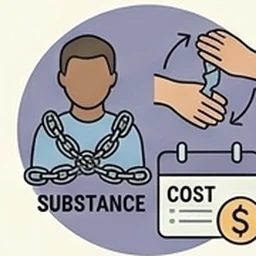
substance use disorder을(를) 앓는 가족을 돌보기
Caring for a family member with substance use disorder
Substance use disorder reshapes a family in ways most caregiver frameworks don't cover. The patient is often resistant to treatment, the medical system isn't built to coordinate with families, and the cost — financial, emotional, and across generations — is unusually high. Here's the orientation, with the harm-reduction reality the field has settled on.
가족에게 무엇이 달라지는가
Substance use disorder (SUD) — alcohol use disorder, opioid use disorder, stimulant use disorder, and others — is a chronic, relapsing medical condition with disproportionately high family caregiving burden. The family's role is shaped by several patterns that don't fit other chronic diseases. The patient's relationship to treatment is often ambivalent or actively resistant; the "they have to want it" framing is partially true but oversimplified (motivation is itself something treatment helps build). The medical system's coordination with families is weak — addiction medicine is poorly integrated with primary care, mental-health, and emergency medicine in most regions. The harm-reduction reality the field has consolidated around — naloxone in every home with an opioid user, never use alone, fentanyl test strips, medication-for-addiction treatment (MAT) for opioid use disorder — sometimes conflicts with the abstinence-only models families were raised with. The overlap with serious mental illness, with trauma, with chronic pain, and with other chronic diseases is substantial; treatment that addresses only the substance use without the underlying drivers often fails. And the financial + legal + custody consequences often layer on top of the medical reality in ways most families weren't prepared for.
일찍 마련해두어야 할 것들
진단 직후의 시기는 가족이 앞으로의 여정 전체가 의지하게 될 구조를 잡을 수 있는, 가장 여유가 있는 때입니다. 미룰수록 아래의 일들 가운데 일부는 점점 더 어려워집니다.
- Naloxone (Narcan) in every home where opioid use is present. Available over-the-counter as a 4mg nasal spray; most insurance covers it; community-distribution programs give it away free. The overdose-reversal medication that saves lives — including in situations where the family didn't know opioids were being used.
- Connection to SAMHSA's 24/7 helpline (1-800-662-4357). Free, confidential, in English + Spanish, doesn't require insurance. Treatment locator, family-resource referrals, crisis support.
- Education about medication-for-addiction treatment (MAT). For opioid use disorder, buprenorphine (Suboxone) and methadone are evidence-based, life-extending treatments that reduce overdose deaths by 50%+. Family understanding + support for MAT — vs. the still-common "you're just trading one drug for another" framing — measurably improves outcomes.
- A Family-to-Family-style program — Al-Anon (for families of people with alcohol use disorder), Nar-Anon (for opioid + other drugs), SMART Recovery Family & Friends. Peer support specifically for family members of someone with SUD. The relief of meeting others who understand the dynamic is structurally important.
- Legal documents while the patient is well enough to sign — durable POA for healthcare and financial decisions, advance directive, sometimes a substance-use-specific advance directive that documents the patient's preferences for future treatment.
- A safety plan that includes financial separation if needed. Joint accounts, shared credit cards, joint mortgages — these can become vectors for financial harm during active use. Separating doesn't mean abandoning; it means protecting the family's ability to keep helping over the long term.
가장 힘든 순간들
가족들이 가장 힘들었다고 말하는 순간들은 종종 누구도 미리 알려주지 않은 순간들입니다. 무엇이 올 가능성이 있는지 안다고 해서 이 순간들이 쉬워지지는 않습니다 — 그러나 이 순간들에 이름을 붙일 수 있고, 그 순간이 닥쳤을 때 가족을 다시 모이게 해주는 공간이 있다면 도움이 됩니다.
- An overdose. For opioid use disorder specifically, overdose is often the moment that reshapes the family's relationship with the patient and with the disease. Survival depends on naloxone availability + someone present. Post-overdose is one of the highest-risk periods for re-overdose; treatment access in the first 72 hours matters.
- A relapse after a period of recovery. The shame, the grief, the practical scramble — all real. The medical fact: relapse is part of the chronic-disease pattern of SUD; the question is how the family + the treatment team respond to it. Most evidence supports rapid re-engagement with treatment, not punishment.
- The decision about boundaries vs. continued engagement. "Letting them hit bottom" is an idea that's done real damage; modern addiction medicine doesn't support it. But there are limits to what a family can absorb. Where to draw boundaries is genuinely hard; therapists experienced in family-of-SUD work help.
- When SUD interacts with parenting — custody decisions, child-protective-services involvement, the impact on grandchildren. The intergenerational pattern is real, and breaking it is real work. Family therapy specifically helps; isolated individual treatment for the person with SUD often misses this dimension entirely.
이 질환과 연결되는 플레이북
Kintaria의 플레이북은 이 돌봄 여정에서 실제로 나타나는 구체적인 순간들을 위한 단계별 안내입니다. 각각은 여러분의 워크스페이스에서 열리고, 여러분의 답변에 맞추어 개인화됩니다.
- Wellness · OngoingWhen you're burning out.
- Spouse · OngoingWhen you are the caregiver-spouse.
- Foundation · One-time setupGet the legal paperwork in order.
- Parent · Financial interventionWhen your parent's bills become a problem.
- Sibling · Inheriting the careYour parent was caring for your sibling — and now they can't.
전국 단체와 상담 전화
이 단체들은 업계에서 표준적인 출발점으로 여기는 곳들입니다. 모두 무료이며, 모두 실제 사람이 받는 상담 전화입니다(돌봄제공자용 AI 전화 상담은 별개의 범주이며, 여기에서는 해당 질환에 대해 훈련받은 사람을 의미합니다).
- 1-800-662-4357 · 24/7 · English + Spanish
The federal substance-use + mental-health helpline. Free, confidential, no insurance required. Treatment locator (FindTreatment.gov), referrals to family-support programs. The single best first call.
- Meeting Information · 1-888-425-2666
For families + friends of people with alcohol use disorder. Peer-support meetings in person + online, the Family Group Conference Approved literature, sponsor program. The longest-established and most-attended SUD family-support organization.
- 1-800-477-6291
For families + friends of people with substance use issues (opioids, stimulants, marijuana, others). Same model as Al-Anon — peer-support meetings, literature, sponsor program. Local groups across the country and online.
A secular, evidence-based alternative to Al-Anon / Nar-Anon. Uses CRAFT (Community Reinforcement and Family Training) — the most-studied family-side SUD intervention. Online and in-person meetings.
- Parent Helpline · 1-855-378-4373
Family-focused organization specifically. Parent helpline (real people, 24-hour callback), one-to-one coaching with trained parent coaches, peer-support community, harm-reduction resources.
Recovery-community advocacy. Local recovery-community organizations across the country offer peer recovery support that complements clinical treatment; the family connection points are deep.
NIH National Institute on Drug Abuse + National Institute on Alcohol Abuse and Alcoholism family-side resources. Authoritative, plain-language, free.
Kintaria 워크스페이스가 어떻게 돕는가
Kintaria는 이 진단이 만들어낼 일들을 위해 설계된, 차분하고 공유되는 가족 워크스페이스입니다. 약 목록은 한 곳에 모여 있어, 주말에 비행기로 오는 셋째 형제자매가 무엇이 바뀌었는지 다시 처음부터 익힐 필요가 없습니다. 진료 일정은 공유되어 있어, 가족이 일정이 겹치거나 류마티스내과 추적 진료를 놓치는 일이 줄어듭니다. 활동 기록은 누가 무엇을 했는지에 대해 정직하기 때문에, 주 돌봄제공자가 모든 일을 조용히 떠안지 않게 됩니다. 그리고 워크스페이스는 이중 언어입니다 — 환자는 자신이 더 편한 언어로 읽고, 가족은 영어로 읽습니다 — 진단 자체가 이미 정신을 어지럽게 만드는 상황에서, 이 점은 사람들이 예상하는 것보다 훨씬 더 중요합니다.
처음 500가족에게 1년 무료 체험을 제공합니다. 신용카드가 필요하지 않습니다.
Kintaria가 무엇인지(그리고 아닌지)에 대한 안내
Kintaria는 임상 도구가 아니며, 의학적 의사결정을 대체하지 않고, substance use disorder 치료팀을 대신하지도 않습니다. 이 페이지의 안내는 돌봄을 조율하는 가족을 위한 것이고, 구체적인 임상 결정은 환자의 담당의가 내려야 합니다. 워크스페이스 곳곳에서 안내되는 escalation 신호는 그 경계에 대해 정직합니다.
이 페이지에서 사용된 돌봄 용어
읽으시면서 뜻을 알고 싶을 수 있는 단어들입니다. 각 단어는 별도의 페이지로 열리며, 쉬운 말로 정의와 돌봄 현장에서 어떻게 등장하는지를 설명합니다.
- Power of attorney — A legal document where one person (the "principal") authorizes another person (the "agent" or "attorney-in-fact") to act on their behalf in financial matters.
- Advance directive — A written document specifying a patient's wishes for end-of-life medical care — typically covering CPR, mechanical ventilation, artificial nutrition, and other interventions when recovery is unlikely.
함께 보기: 모든 질환 · 모든 플레이북 · 돌봄제공자 용어집 · 전국 자원 디렉터리