inflammatory bowel disease을(를) 앓는 가족을 돌보기
Caring for someone with IBD (Crohn's or ulcerative colitis)
IBD is the chronic illness that families often don't talk about — partly because the symptoms are embarrassing, partly because the disease is unpredictable, partly because most patients are diagnosed young and the caregiver is often a spouse or parent of an adult child. Here's the orientation.
가족에게 무엇이 달라지는가
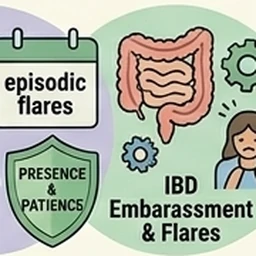
Inflammatory bowel disease — Crohn's disease and ulcerative colitis — is an autoimmune attack on the digestive tract that produces a chronic course with flares and remissions. ~3M Americans have IBD; most are diagnosed between ages 15-35, meaning the family caregiver is often a parent of a teenager or young adult, a spouse, or sometimes a college roommate-turned-partner. The caregiving role is shaped by the disease's peculiarities: bathroom urgency that reshapes daily life and travel; pain that's often dismissed or hidden; medication regimens that include immunosuppressants (with infection risk) and biologics (with infusion logistics and high cost); the surgical track that affects ~70% of Crohn's patients eventually and many UC patients; and the embarrassment-driven isolation that makes IBD different from most chronic diseases. Pediatric-onset IBD adds its own arc: parents become the medical-decision-makers, then the relationship transitions as the patient becomes an adult who manages their own care. Late-stage Crohn's with multiple surgical resections can lead to short bowel syndrome and parenteral nutrition — a level of caregiving most families weren't briefed about at diagnosis.
일찍 마련해두어야 할 것들
진단 직후의 시기는 가족이 앞으로의 여정 전체가 의지하게 될 구조를 잡을 수 있는, 가장 여유가 있는 때입니다. 미룰수록 아래의 일들 가운데 일부는 점점 더 어려워집니다.
- A gastroenterologist who subspecializes in IBD (not just general GI). Outcomes are measurably better with IBD-specific care; large medical centers often have a dedicated IBD center with multidisciplinary teams.
- Connection to the Crohn's & Colitis Foundation chapter in your area. Patient + family support groups, IBD Help Center, financial assistance for medications, "Camp Oasis" summer camp for kids with IBD.
- A written flare plan from the gastroenterologist. What to do at home, when to call the office, when to go to the ED. Most IBD centers give one; if yours hasn't, ask. Caught-early flares often respond to oral steroid courses; missed flares often mean hospitalization.
- Insurance + financial setup for biologic medications. Most IBD biologics cost $50K-$80K/year; co-pay assistance programs exist for almost every one of them but require active enrollment. The Crohn's & Colitis Foundation's patient-aid team helps families navigate this.
- A nutrition consultation. IBD nutrition is unusual — what works during a flare is different from what works during remission; some patients benefit from elemental diets for flare control; ostomy patients have their own nutritional considerations. A registered dietitian familiar with IBD makes a real difference.
- A family conversation about how visible to make the disease. Most patients oscillate between hiding the disease entirely and being more open. There's no right answer, but the family's posture (treating it as ordinary vs. treating it as shameful) shapes the patient's relationship with it for years.
가장 힘든 순간들
가족들이 가장 힘들었다고 말하는 순간들은 종종 누구도 미리 알려주지 않은 순간들입니다. 무엇이 올 가능성이 있는지 안다고 해서 이 순간들이 쉬워지지는 않습니다 — 그러나 이 순간들에 이름을 붙일 수 있고, 그 순간이 닥쳤을 때 가족을 다시 모이게 해주는 공간이 있다면 도움이 됩니다.
- A first severe flare that requires hospitalization. The visible toll — weight loss, dehydration, sometimes blood transfusion — is hard for families to witness. Most flares respond to treatment; reframing as "this is the disease, not the patient losing control" helps.
- The first surgery — often colectomy for UC or bowel resection for Crohn's. The decisions about ileostomy + j-pouch vs. permanent colostomy are heavy and patient-specific. Most patients describe the post-surgical period as significantly better quality of life than they expected.
- Living with an ostomy. The cognitive and emotional adjustment is real and rarely briefed in advance. The United Ostomy Associations of America peer-mentor program is the most useful resource families consistently underuse.
- The transition from pediatric to adult care. For patients diagnosed as kids or teens, the handoff to adult GI happens between 18-22; the parent's role formally ends but rarely actually ends. Most pediatric IBD centers have transition programs; ask about yours.
이 질환과 연결되는 플레이북
Kintaria의 플레이북은 이 돌봄 여정에서 실제로 나타나는 구체적인 순간들을 위한 단계별 안내입니다. 각각은 여러분의 워크스페이스에서 열리고, 여러분의 답변에 맞추어 개인화됩니다.
- Spouse · OngoingWhen you are the caregiver-spouse.
- Adult child · Age 18 to 22Your adult child is aging out of school-based services.
- Foundation · One-time setupGet the legal paperwork in order.
- Wellness · OngoingWhen you're burning out.
- Parent · This is real nowYour parent is in the ER for the first time.
전국 단체와 상담 전화
이 단체들은 업계에서 표준적인 출발점으로 여기는 곳들입니다. 모두 무료이며, 모두 실제 사람이 받는 상담 전화입니다(돌봄제공자용 AI 전화 상담은 별개의 범주이며, 여기에서는 해당 질환에 대해 훈련받은 사람을 의미합니다).
- IBD Help Center · 1-888-694-8872
The patient + family IBD organization in the US. IBD Help Center, support groups in person + online, patient-and-family educational materials, "Power of Two" peer-matching program, Camp Oasis (free camp for kids with IBD).
- Helpline · 1-800-826-0826
For patients with ostomies (a meaningful share of IBD patients after surgery). Peer-visitor program — trained ostomates who visit pre- and post-surgery patients. The single most-recommended ostomy resource by surgeons + nurses.
Patient-led, social-media-native community for younger IBD patients. Strong on the realities of dating, careers, parenting, and college life with IBD — topics the older clinical orgs underweight.
Focused on the experience of Black and Latino IBD patients — historically under-represented in IBD research and care. Patient stories, advocacy, education.
- 1-800-532-5274
Not IBD-exclusive but runs case-management for biologic-treatment access (denials, prior auths, copay issues). Useful when insurance fights are the bottleneck.
Authoritative US government plain-language overview. Free, comprehensive, available in English + Spanish.
Kintaria 워크스페이스가 어떻게 돕는가
Kintaria는 이 진단이 만들어낼 일들을 위해 설계된, 차분하고 공유되는 가족 워크스페이스입니다. 약 목록은 한 곳에 모여 있어, 주말에 비행기로 오는 셋째 형제자매가 무엇이 바뀌었는지 다시 처음부터 익힐 필요가 없습니다. 진료 일정은 공유되어 있어, 가족이 일정이 겹치거나 류마티스내과 추적 진료를 놓치는 일이 줄어듭니다. 활동 기록은 누가 무엇을 했는지에 대해 정직하기 때문에, 주 돌봄제공자가 모든 일을 조용히 떠안지 않게 됩니다. 그리고 워크스페이스는 이중 언어입니다 — 환자는 자신이 더 편한 언어로 읽고, 가족은 영어로 읽습니다 — 진단 자체가 이미 정신을 어지럽게 만드는 상황에서, 이 점은 사람들이 예상하는 것보다 훨씬 더 중요합니다.
처음 500가족에게 1년 무료 체험을 제공합니다. 신용카드가 필요하지 않습니다.
Kintaria가 무엇인지(그리고 아닌지)에 대한 안내
Kintaria는 임상 도구가 아니며, 의학적 의사결정을 대체하지 않고, inflammatory bowel disease 치료팀을 대신하지도 않습니다. 이 페이지의 안내는 돌봄을 조율하는 가족을 위한 것이고, 구체적인 임상 결정은 환자의 담당의가 내려야 합니다. 워크스페이스 곳곳에서 안내되는 escalation 신호는 그 경계에 대해 정직합니다.
함께 보기: 모든 질환 · 모든 플레이북 · 돌봄제공자 용어집 · 전국 자원 디렉터리